
Building a tennis court is so much more than just laying down a flat surface – it’s a proper engineering project, one that needs to marry up precision, durability and top-notch performance. Whether you’re planning tennis court construction for a family home, a school or a pro-grade academy, the whole thing rests on having a solid plan in place, using the best quality materials and following established international building standards. With over two decades of experience in synthetic acrylic sports flooring, I have seen how the right foundation and surface system can turn any open space into a world class arena. The most reputable tennis court builders know that from soil testing and slope design to coating selection and line marking, every stage of how to make a tennis court requires attention to detail and technical knowhow.
This all-encompassing guide will walk you through the process, from picking the right spot for your court to pouring the base, right through to the surfacing, pricing it all up and keeping it in good nick. Whether you’re just wondering how to make a tennis court and how much these courts cost to build or you’re looking to find the best tennis court company to get the job done, this guide is here to provide the info you need to make some smart, long-term decisions that give you consistent play, keep everyone safe and look great – and look properly professional.
Tennis Court Construction Basics – Understanding How to Make a Tennis Court
What Is A Tennis Court Made Of?
A professional tennis court is made up of three essential components — the base surface system and finishing elements like lines, fencing and lighting. Each layer works together to provide structural strength, consistent bounce and all weather playability. The most common tennis court surfaces are asphalt for affordability, concrete for durability and synthetic acrylic coatings for traction and UV protection. Acrylic systems are applied in multiple layers making them ideal for tennis court construction in India’s varied climate.
Key Benefits Of Synthetic Acrylic Tennis Court Flooring
- Durability – Because An Acrylic Tennis Court Surface Can Last Over A Decade Without Needing Too Much Maintenance, Even When Exposed to UV Rays, Prolonged Rain and Heavy Use.
- Grip: These surfaces are textured with fine silica sand to give them a subtle grip, which in turn gives you better traction and controlled ball bounce. More player confidence, less risk of injury during those high-intensity rallies.
- UV-Resistance: High grade pigments used in acrylic tennis court material resists color fading and heat related deterioration, so the surface remains vibrant and stable in direct sunlight.
- Low Maintenance: Unlike clay or grass surfaces acrylic courts only need an occasional clean and don’t need resurfacing till every 5 – 7 years. The Long & Short of It Is – That Saves A Whole Lot Of Time & Money In The End
Step 1 – Choosing & Preparing The Site
Select a site that has been properly chosen & prepared – it’s gonna ensure durability, good drainage, & the court plays even good all the years to come.
- Topography – Why a Flat or Gently Sloping Site is Really Important (1:100) – It’s a lot easier to grade a level or mildly sloping site & that helps keep the tennis court flooring in top shape. A 1:100 slope is the way to go – that’s as much slope as you need, that way the water runs off easily without messing with the ball bounce or making people slip.
- Drainage – Why a Good Drainage System Keeps the Court Dry and Crack Free – You really need good drainage to keep the court from getting waterlogged & cracking during the monsoon season. Installing some perforated sub-surface pipes & a channel around the perimeter makes sure rainwater gets diverted away from the court & you get a longer life out of the tennis court material.
- Soil Condition – Getting the Soil Right, or the Court Will Suffer – The soil that the court sits on is key to its long term stability & how well it’s gonna play. If you’ve got weak or clayey soil you need to compact it down or stabilize it so it’s got a solid base that can handle all the weight of the tennis hard court material & not just sink down after a while.
- Obstructions – No Trees, Poles or Shadows Please – It’s worth avoiding having any trees, poles or boundary walls nearby – they can end up casting uneven shadows, letting debris build up, & even causing roots to grow into the foundation. Pick a nice open spot & you should get balanced sunlight, safe play & great tennis court surface material all the time.
Asphalt v Concrete – Choosing the Right Tennis Court Base
To be honest, most tennis clubs, schools and people with residential projects just can’t go past the flexibility and affordability of asphalt. It’s by far the most widely used material for how to make a tennis court – mainly because it does the job well enough and doesn’t break the bank.
- Getting the sub base right- The first step is to carefully dig out the area to the right depth and then build up a layer of compacted crushed stone or gravel. This base needs to be firm and strong enough to support the weight of the court and all the play on it.
You also want to make sure the base slopes away from the court at a rate of about 1:100, so that water can run off without pooling or eroding the base – which will shorten the life of the court. - The importance of drainage and perimeter control- You’ll find that most decent tennis courts have drainage channels fitted to the edges of the court, these capture rainwater and send it away from the base and the synthetic acrylic surface – stopping waterlogging and structural damage that can cause the tennis court surface material to become uneven or worn out.
- Installing the base layer- If you’re going with an asphalt base in how to make a tennis court, you’ll need to lay down a 1.5 to 2.5 inch layer of hot bitumen mix, then compact it to the right level and cure it so that it’s nice and elastic and even.
If you go for a concrete base however you can expect to get a seriously strong and level base – either with a reinforced M20 slab or a post tensioned design to give you that extra bit of strength and crack resistance.
Step 2 – Laying the Tennis Court Surface in How to Make a Tennis Court
Standard Synthetic Acrylic Layer System
- Primer Coat – The Glue That Holds It All Together & Keeps Moisture Out – The primer coat goes right over the asphalt or concrete, sticking it down so that the top layers will last. It seals up all the tiny cracks and holes so that moisture can’t get in and cause problems down the line.
- Resurfacer Coat – Getting It Down To Size & Texture – This next layer smooths out any bumps and fills in any holes to make the surface as smooth as can be. It’s like a draughtsman’s level – making sure everything is perfectly even and ready for the next layer. Mixed with silica sand, it gives traction and controls the ball speed, so players get a consistent experience across the entire tennis court flooring.
- Cushion Layers – Comfort & Shock Absorption (Optional)- Made of rubberized acrylic materials, cushion layers absorb the impact and reduce player fatigue during long hours. These layers give a soft, responsive feel underfoot – a favorite for professional academies and high-end tennis court projects.
- Color Coats – High-quality acrylic color coatings are applied in contrasting colors like blue and green to define the play area and run-off zones. These UV-resistant coats protect the tennis court from sun, rain and wear, keeping the tennis court material looking vibrant and weatherproof for years.
- Line Marking – ITF Regulation Layout- The final step is line marking using ITF-standard, white acrylic sports paint. We mask and paint the 5 cm wide lines to perfection to give them a professional look and clear visibility during competition.
Step 3 – Dimensions, Layout, and Markings
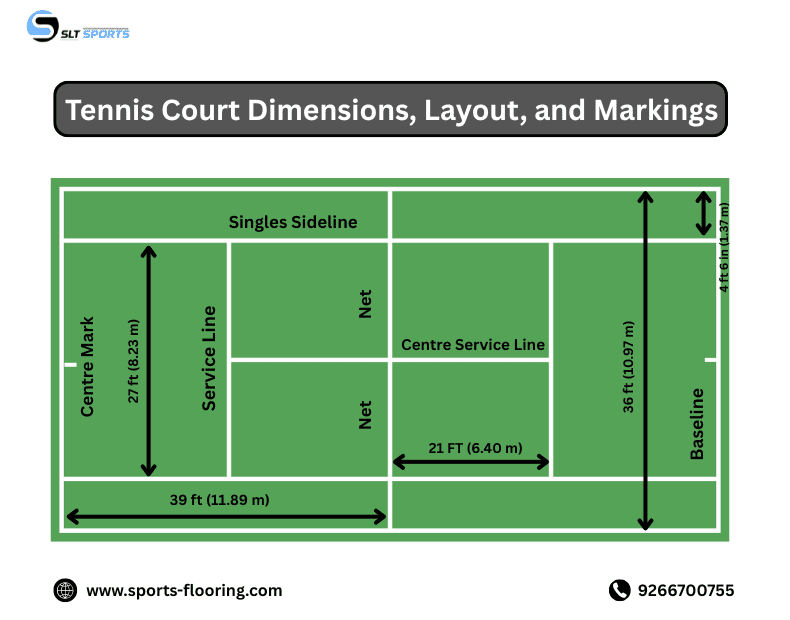
Tennis Court Dimensions – What You Need to Know
A standard tennis court follows the ITF dimensions – 78 feet (a bit over 23.7 meters) long and 36 feet (just under 11 meters) wide for doubles, while singles play can get by with a 27 foot (around 8.2 meters) width. And then there’s the run-off area behind the baseline – 21 feet to keep players safe, and 12 feet along the sidelines for the same reason. The orientation of the court can also make a difference – we aim for a north-south orientation to keep the sun out of players’ eyes during matches.
- Tennis Court Accessories & Finishing Elements- When it comes to a pro tennis court installation, the details count – sturdy center posts, reliable nets, decent fencing, and good quality LED lighting will keep players going for hours. Other add-ons like benches, umpire chairs, and drainage systems aren’t just nice to have – they make a real difference to the court setup.
- Tournament-Level Aesthetics & Finishing Touches- Experienced tennis court builders know it’s in the fine details that the really good courts stand out. Precise line marking, good color contrast, and a super smooth surface all meet ITF standards. And that’s not just about performance and visibility – the end result is a premium look that’ll make your court look like the real deal.
Step 4 – How Much Does a Tennis Court Cost in India?
Factors That Affect the Bill
- 1. Site Condition- The starting point is how to make a tennis court is easy or hard it is to build on the site – how much grading, leveling and soil stabilization do you need to do before you can even start laying down the court? The amount of prep work required increases the overall project expense.
- 2. Base Type– You’ve also got to choose between asphalt and post-tensioned concrete – and one is going to be a lot more expensive than the other. Asphalt might be the more affordable option now, but concrete will mean less maintenance (and potentially lower costs) down the line.
- 3. Acrylic Coatings- The number of acrylic coatings you go with (5-layer non-cushioned to 8-layer cushioned) has a pretty big impact on the overall price – more layers will give you better performance and a longer lifespan, but that does come at a cost.
- 4. Fencing & Enclosures- Perimeter fencing is essential, not just for safety and ball containment, but also for the overall look of the court. And, of course, the material you choose and how high you go will impact the cost. But it is worth it for the extra security and a top-notch look.
- 5. Lighting Setup- Putting in LED lights extends the amount of time you can play and makes the court a lot more usable in the evenings, but that does come at a price. What you really want is a system that’s energy-efficient and can handle India’s climate and the demands of a big tournament.
Average Price Range (With Table)
| Type | Material | Lifespan | Cost Range (₹ per sq. ft) |
| Asphalt + Acrylic | Hard Court | 10–15 years | ₹150–₹180 |
| Concrete + Cushion | Premium | 20–25 years | ₹200–₹300 |
Long-Term Savings- High quality tennis court flooring built with durable acrylic systems saves you money in the long run.
Step 5 – Maintenance, Resurfacing & Repairs For How To Make A Tennis Court
- Tennis Court Flooring Maintenance – Regular sweeping and gentle washing prevents dust, leaves and debris from dulling the surface or blocking drains. Proper drainage means your tennis court flooring stays clean, slip free and performs all year round.
- When to Resurface Your Court – Every 5-7 years fading colors, reduced grip or minor cracking means it’s time to renew. Scheduling timely tennis court resurfacing near me keeps the court looking great, safe and tournament ready and extends its life.
- Certified tennis court installation companies – It should immediately repair small cracks, peeling acrylic, or water damage. Professional teams use special materials and equipment to restore the texture and prevent long term structural damage.
Step 6 – Picking the Right Tennis Court Builder
What Makes Top-Notch Tennis Court Builders- You can tell if a tennis court builder is the real deal by looking for their ITF certification – that tells you they’re using methods and materials that meet the international standard for play – and also it’s not just about the flooring, it’s the whole package, the base construction too. The best ones will also give you the full package of installation expertise and ongoing support – so you know you will get help with resurfacing, repairs and maintenance when you need it.
Why Go With a Pro Tennis Court Maker- Working with a company that’s been around the block a few times in the tennis court business means they know what they’re doing. Proven materials handle all climate conditions in every layer of the court, from the primer to the line painting. You get a one-stop shop with an experienced manufacturer: they’ll provide the materials, help with the design, do the installation, and back it all up with a warranty – all of which adds up to a tennis court that’s going to last and perform consistently and look top-notch.
Conclusion
A perfect tennis court is a combination of precision, quality and expertise. Every layer from base to top acrylic coat plays a crucial part in a court that performs under all weather conditions. Choosing the right tennis court surface not only improves play but also reduces long term maintenance and resurfacing costs.
Whether you’re a school planning a multi court complex or a homeowner designing a personal sports space, working with an experienced tennis court contractor ensures your investment lasts. ITF approved tennis court manufacturers and installers provide materials, methods and after sales support to give years of trouble free performance.
In short, building a tennis court is an investment in durability, looks and player experience. With proper planning, skilled craftsmanship and top grade tennis hard court surfaces your court will play like a world class court – season after season.
Frequently Asked Questions
To make a tennis court step by step: select a site, prepare the base, ensure proper slope and drainage, lay asphalt or concrete, apply primer, resurfacer, cushion, and color coats, then finish with ITF-approved line markings.
The cost to build a tennis court typically ranges from ₹15 lakh to ₹40 lakh in India, depending on the base, surface system, and additional features.
Builders create a tennis court using an asphalt or concrete base topped with synthetic acrylic layers for durability, grip, and consistent bounce.
The best material for a tennis court is synthetic acrylic flooring, offering superior durability, UV resistance, and consistent ball bounce in all weather conditions.
The requirements for a tennis court include a level asphalt or concrete base, proper drainage and slope (1:100), ITF-standard dimensions (23.77 m × 10.97 m), quality acrylic surface coatings, and clear line markings.