
Badminton facilities all over India – from neighbourhood clubs and schools to big-time academies and fully-fledged arenas – are busier than ever. As a result of non-stop training sessions, tournaments and casual play throughout the day, deciding on the right badminton court material is a no-brainer – it’s all about safety, how well it holds up & long-term performance. Courts that handle a lot of foot traffic take a pounding when you choose the wrong material, wearing down fast, losing grip, and fading quickly. That’s why it’s really important to get your head around what makes a good badminton court flooring, how you put it together and what materials you should look for as an owner, builder, or someone advising on sports facilities with SLTSports solutions.
This guide takes the engineering know-how & combines it with real world decision-making so you can pick the best badminton court surface material for indoors or outdoors. Synthetic badminton court systems, acrylic flooring technology, and the finer details of the build directly affect how long a court lasts—especially in places that get a lot of use, something SLTSports installations clearly show—and this gives you the full lowdown.
Why Heavy Footfall Demands Special Badminton Court Material
You can’t just take a badminton court lightly if you’ve got a lot of players coming and going – especially if it’s in an academy or a public venue that’s used by just about everyone. The thing is, all those feet dragging, sliding and pivoting around on the surface creates a whole lot of friction – and if you’re using a low-quality surface, that friction is only going to accelerate wear and tear while also making the court feel all dull and flat. To put it bluntly, courts like that are bound to fall apart after a while.
That’s where courts designed for heavy use really start to shine. They require a special kind of flooring that’s been engineered to grip and last, with a layered material that’s going to withstand all the punishment that players can dish out. And it’s not just the court surface itself that needs to be tough – it’s the whole sub-base underneath that gets impacted too. That’s to say, poor construction can leave you with a base that’s going to start to break down pretty quickly – and once that happens, the whole court starts to lose its ‘bounce’ so to speak. But if you use a high-quality synthetic flooring system such as SLTSports synthetic systems, you can count on it to hold up, with a multi-layer coating and some durable polymers that’ll keep the whole court feeling safe and stable, even after a long day’s play.
Key Factors to Consider While Choosing Badminton Court Material
Choosing the right badminton court surface material depends on how each factor affects durability. Courts with high footfall need special flooring that still has traction after thousands of footsteps. A good quality badminton floor can withstand friction, temperature changes and repeated shuffling without losing grip.
Below are the key factors, each explained in detail:
Grip & Traction
Good traction is important because badminton involves sudden stops, quick lunges and rapid direction changes. High quality badminton court flooring maintains its grip even under continuous use, no slipping and falling. Players rely on the right amount of friction for fast gameplay and poor grip increases injury risk. That’s why acrylic based badminton court material with controlled texture is perfect for outdoor and indoor areas with high traffic.
In high footfall areas, grip must remain consistent even when the surface is slightly dusty or exposed to mild moisture. The texture of synthetic badminton court surfaces is engineered to maintain grip in most conditions. That’s why they are the most reliable option for schools, academies and clubs where constant usage is expected.
Shock Absorption
Shock absorption is a pretty crucial factor in determining just how much of an impact is transferred from the court to your poor knees and ankles. Now, a good badminton flooring material will absorb enough of that impact to keep you going for hours on end. This is especially important in outdoor training centres where students can be pounding that court on a daily basis. Flooring systems made from cushion acrylics and PU floors are great at reducing fatigue – so you can keep on going even when you’re putting your feet through their paces on a heavy day of training.
Synthetic layers in badminton court synthetic surfaces create a bit of micro-cushioning that does a great job of protecting those joints of yours – while at the same time keeping the court firm enough that you can still get a great run on it. A balanced shock absorption layer is also key to really getting the most out of your game, and ensuring that the surface lasts and lasts even under extreme conditions.
UV & Weather Resistance
When it comes to outdoor badminton court flooring, keeping the surface from fading – or indeed turning brittle in the extreme heat – is a big priority. UV stability is pretty much a must-have: anything else will have the colors wearing off in no time, leaving your court looking like it’s been through a bit of a rough time. High-quality acrylic badminton court material usually comes with some pretty top-notch UV-resistant polymers these days that can handle the heat. Result? No surface cracking, color fading, or premature wear.
And then there’s the rain – which can be just as much of a challenge as the sun. But the thing is, a good weather-resistant badminton court surface material will let you play on – even after a few days of heavy footfall and bucketloads of rain. The acrylic surface dries in no time, so you can get back to playing straight away. No wonder it’s the most trusted choice for outdoor use all round.
Durability Under High Usage
Durability is how long the court will last before needing resurfacing. Heavy traffic courts especially in academies and public sports parks need robust badminton floor systems. Multi-layer acrylic or PU coatings prevent the surface from peeling or fading prematurely.
High durability synthetic badminton court setups are designed for consistent play after thousands of hours of use. By resisting abrasion and maintaining texture these surfaces minimize maintenance costs and provide stable play. That’s why durability is one of the top priorities when choosing a badminton court.
Best Badminton Court Materials for Heavy Footfall Areas
Understanding the materials helps you make better decisions based on environment, budget and traffic.
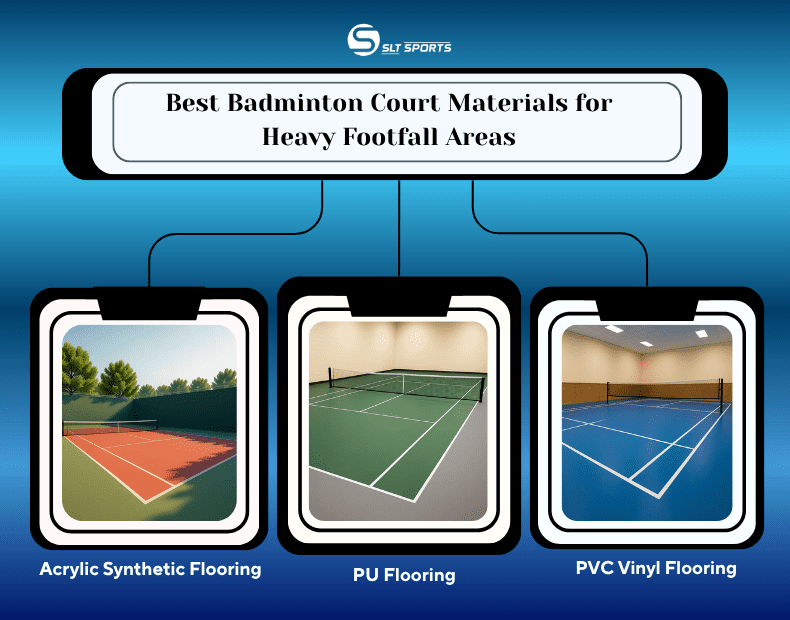
Acrylic Synthetic Flooring (Most Preferred for Outdoor & Semi-Indoor)
Acrylic is the industry standard for outdoor badminton court flooring because of its excellent grip, colour retention and weather resistance. It’s a multi-layer system that can withstand high footfall without losing performance. Perfect for schools, academies, clubs and public play areas that rely on SLTSports acrylic quality.
Acrylic badminton court material delivers reliable grip and bounce consistency. The surface texture remains stable after countless training sessions. The layered structure enhances durability making it the ideal synthetic badminton court flooring. With optional cushion layers acrylic floors also provide better shock absorption.
The system is available in 5-layer, 7-layer and 8-9 layer formats. These options balance cost, comfort and performance making acrylic the top choice for outdoor synthetic badminton court projects.
PU (Polyurethane) Flooring (Best for Indoor Academies)
PU flooring gives a whole lot more shock absorption and a lot more comfort for indoor facilities compared to any other flooring. It’s a real seamless, highly elastic and super resistant to impact – which makes it a top choice for pro and high performance indoor arenas.
PU systems are able to give consistent grip even after hours of daily use and that is totally important in high traffic indoor areas. And this type of badminton court surface material also goes a long way to protect joints and reduce the risk of injury. Because PU courts are so durable and they last so long, it’s a great value for serious training facilities that put a lot of use into their floors.
While PU systems will cost a bit more than acrylic, we have to say they provide way better performance and longevity for indoor courts that have to deal with heavy footfall. For premium academies they offer an unmatched level of resilience for constant play.
PVC Vinyl Flooring (Budget-Friendly Indoor Option)
PVC is used in schools, halls and budget friendly indoor setups. Easy to install and basic cushioning. But not suitable for extreme heavy footfall areas as it wears down faster.
Vinyl based badminton floor material may need to be replaced more often especially under heavy usage. So it’s good for short term solutions but not for long term heavy foot traffic. PVC is only recommended for low to medium use facilities – not for serious training academies.
Complete Badminton Court Construction Details for Durability
Even the best badminton court material will fail if the underlying construction is not done properly. The base, resurfacing and layer application all plays a big role on how long the court will last under heavy footfall.
Building an Outdoor Badminton Court – Construction Details
When building an outdoor badminton court, the first thing you need to think about is a solid foundation that can withstand the elements. The step-by-step guide below helps you get started.
Laying the Groundwork – Sub-Base Construction
A really good outdoor badminton court needs a foundation made from M20-grade concrete that’s got a 1:100 slope to ensure water drains off easily. This helps prevent water from waterlogging and damaging the surface. And don’t forget to give that concrete time to cure – 21-28 days is the standard period to allow it to reach full strength. The result is a sub-base that can take all the heavy footfall of a busy badminton court without breaking a sweat.
Preparing the Surface
To get a smooth, even surface, you apply an acrylic resurfacer to cover up any bumps and cracks. This also ensures the paint sticks properly – and when you’re dealing with a badminton court, you want that paint to last as long as the court itself. A proper job on the surface prep is what keeps your badminton court flooring looking and feeling great.
Building Up a Good Layer – Acrylic Layering
You apply multiple layers of acrylic for grip, durability and to get the color just right. If you want, you can also add a cushion layer for extra comfort. And when you finish the installation, the outdoor badminton court flooring takes all the punishment it gets without losing its stability.
Drawing the Lines – Line Marking
To get long-lasting line markings that still look great, you must use high-quality acrylic paint designed for the job. It makes a big difference to the overall look of the synthetic badminton court – if it’s marked properly, it’s a pro set-up that’s the business.
Building An Indoor Badminton Court – Here’s What You Need To Know
Indoor badminton courts rely on a good balance of cushioning, elasticity, and shock absorption so players can get on with the game without getting battered.
Laying The Base Flooring
First – a strong base. We’re talking concrete or wood here. It has got to be level so the floor is even all over and the game plays fair. And – a stable base makes the whole thing last a lot longer – including the special badminton floor material you choose.
Installing PU or PVC
Now – we get to the good stuff. PU layers give you the best cushioning and durability. PVC is a more budget-friendly option, but you’ll need to put some work into maintaining it. And let’s be real – if you want a good indoor court that lasts, you need a nice stable temperature-controlled environment to keep that fancy synthetic badminton court flooring looking good.
Getting The Lines & Finishing Touches Right
You can’t have a proper court without some decent line marking. That means calling in a pro to get it right and make sure the lines are clear and easy to see. And when the lights come on – the whole thing just looks even more awesome, with the bright colors of the badminton court surface material really popping.
Badminton Court Construction Pricing
Budget is probably the number one consideration when it comes to building heavy footfall badminton courts. Spending the right amount of money not only boosts performance but it also makes a huge dent in long-term maintenance and resurfacing costs. When you understand what you are getting for your money, facility owners can make informed decisions about which materials will deliver the goods – in other words, provide good durability, good value and consistently playable surfaces that can put up with years of use.
Synthetic Badminton Court Price (Acrylic)
₹65 to ₹350 per sq. ft – that’s the sort of money you’re looking at depending on the number of layers and the sort of cushion system you want. And it really is a comprehensive badminton court material package – resurfacer, top coatings, the lot – to give you a surface that will last for ages. The great thing about acrylic is that it is highly customisable, which is why it suits so many different types of places – from schools to clubs to academies to public complexes. And because it is so UV-stable and weather-resistant, you’re really going to cut down on your maintenance bills over the years.
Synthetic Badminton Court Price (PU)
₹280 to ₹600 per sq. ft is the kind of money you’re talking about for a top-of-the-line PU flooring system for indoor badminton courts.
PU courts offer maximum durability and ROI in the long run because of the superior cushioning and elasticity they provide.
They just keep giving you a consistent grip no matter how much you train on them – which is why they are so ideal for professionals and academy-level players.
Okay, yes the initial outlay is higher, but the returns down the line justify it because a PU system gives you unmatched comfort, injury protection, and long-term resilience.
Outdoor Badminton Court Cost
₹3 to ₹8 lakh is the sort of money you’re looking at depending on the base conditions, the ground leveling you need to do and the layering requirements.
High-spec outdoor synthetic badminton court systems can save you a small fortune in the long run by cutting down the number of times you have to repaint and resurface.
Your cost will also depend on the quality of the sub-base, the drainage setup you go for and the type of acrylic cushion system you choose.
And if you invest in good-quality outdoor flooring, that surface delivers long-term performance even in extreme heat, rain, and constant public use.
Indoor Badminton Court Construction Cost
₹8 to ₹18 lakh – that takes into account flooring, lighting, electrics and all the finishing touches.
Indoor PU systems last longer and play better, which is why they are the go-to choice for any high-performance academy.
This sort of money also gets you the structural elements you need like roofing, ventilation and that sort of thing.
And if you invest in good-quality outdoor flooring, you gain long-term performance even in extreme heat, rain, and constant public use.
Which Badminton Court Material Should You Go With?
When it comes to areas that get a lot of foot traffic, acrylic is still the way to go for outdoor badminton court flooring. It’s tough, it can withstand all sorts of weather, and it doesn’t need a lot of fuss and bother to keep it looking good. On the other hand, when you set up an indoor court, you benefit most from polyurethane (PU) because it offers better grip and provides more cushioning.
Both options perform reliably when you fit them properly and follow the right badminton court construction details. Low cost PVC however is definitely not the way to go for heavy use areas. It just doesn’t last.
Conclusion
Choosing the right badminton court material is even more important when you are planning to use the place a lot. If you expect lots of footfall, coaches, and high intensity play going on, you need a material that is on the ball – and acrylic definitely fits the bill for outdoor badminton court flooring with SLTSports standards. It’s resistant to weather, stable to UV light and has multiple layers of strength, which means it can keep up with the daily wear and tear. For indoor courts, the PU is the clear winner – it’s got excellent cushioning, energy return, and gives you that top-grade comfort that’s perfect for the pros and pro trainers.
Fitted properly with the right badminton court construction details, the right base, & done in a systematic way, both acrylic and PU floors deliver a long-lasting court that won’t let you down under heavy use. Low-cost PVC won’t last under heavy use, so choosing it to save money ends up costing you more in the long run because you will have to replace it often.
Ultimately, investing in good quality badminton court flooring will mean your players will be safer and have a better time playing .It will stay in good shape too, and won’t need constant work to keep it running. Choose the right material and your court will go from strength to strength – no matter how many players are using it.
Frequently Asked Questions
Acrylic is the best material for badminton courts in areas that are going to take a pounding.
Its got to be a high-quality acrylic badminton court to last you 4-7 years, but that all depends on just how much use you get out of it and how well you look after it too.
For a new court outdoors, I reckon acrylic is the way to go because it’s tough as nails and can handle whatever the weather throws at it. On the other hand, for indoor courts, PU’s the one that’s going to give you that extra bit of comfort and shock absorption you need.
As for the cost of building a badminton court, that can range from 3 to 4 lakh rupees – and that’s all depending on whether you’re going to be building an indoor or outdoor court, what you’re using for the flooring, any base work you need to do and of course, what materials you choose.
PVC’s only really suitable for the really low budget indoor setups and even then it just can’t take a lot of heavy use – it wears out pretty quick.