
Pickleball is one of the fastest-growing sports out there, and it’s really taking off in India – I’ve seen it sprouting up in schools, sports academies, clubs, residential complexes and all sorts of recreational spots. Now the good news is that the game itself is pretty easy to get the hang of – but getting a top-notch pickleball court dimensions set up can be a lot trickier to nail, especially when you’re getting down to the nitty-gritty of what exactly your court should measure.
It’s not just about following the rules – getting the dimensions right has a direct impact on how well players can move around, whether people are going to get hurt, how the surface of the court is going to play, how well the ball is going to bounce and whether your court is going to last the distance over time. Whether it’s just a little backyard court or a full-on commercial facility with lots of courts, really getting your head around the official dimensions is basically the first rule of success.
This guide is going to break down the standard measurements for a pickleball court – and what that means in real terms – as well as the ins and outs of laying out a court, what sort of lines you need to have on the surface and how much space you need to have around the court for safety. We’re also going to be looking at some special tips and tricks for laying down synthetic acrylic pickleball court flooring that will really stand up to the Indian climate.
What Are the Standard Pickleball Court Dimensions?
A standard pickleball court sticks to USA Pickleball rules and lets both singles and doubles players have a good go on the court. These regulations make sure that the official pickleball court dimensions let everyone play fair, move around properly, and get a smooth court built – no matter whether it’s for a house or a business.
Official Pickleball Court Size
- Width: Twenty feet wide across – that’s the sort of width that lets players move around easily and get into some good rallies, making it perfect for pro-grade pickleball court flooring and pickleball court surface material that really lasts.
- Length: 44 feet from one end to the other – long enough to get the service zones and baselines just right, which means safer play, proper bounces and all the rest, and a pickleball court installation that gets the job done.
These dimensions cover the entire court – from the baseline on one side to the baseline on the other, and from one sideline to the other. Unlike tennis, pickleball uses the same size court for singles as it does for doubles – which is a big help when it comes to planning and marking out the lines on the court during construction.
Pickleball Court Dimensions in Feet and Meters
| Measurement | Feet | Meters |
| Court Width | 20 ft | 6.10 m |
| Court Length | 44 ft | 13.41 m |
| Total Playing Area | 880 sq ft | ~81.75 sq m |
Even though the playing space itself is pretty compact, some serious thought should be given to leaving a decent amount of room around the pickleball court for safety and comfort reasons.
Total Area Required Including Run-Off Space
A common rookie mistake in building pickleball courts is to only focus on getting the court itself built – forgetting all about the clearance zones around it. Ignoring clearance has all sorts of negative impacts – on safety, on movement, and even on how well the court performs in the long term – all of which can end up costing more money for the court down the line and also put a lot more wear and tear on the entire facility.
Recommended Total Space
- Minimum area:The minimum amount of space you should have is 30 ft by 60 ft. That gives you just enough room to allow for a bit of a run-off zone for casual play and still makes it safe for pickleball court installation as long as you also get in some decent quality flooring.
- Ideal area: But the ideal space is even bigger – 34 ft by 64 ft (that’s typically what you’ll see if you’re building a court that’s going to be used by serious players or for competitive tournaments). That extra space makes a huge difference in giving your players room to move around without bumping into each other – and that’s especially important when you’re playing some fast-paced high-level pickleball.
Why Run-Off Space Matters?
- Allows players to move freely without collision– A good solid clearance zone means that your players can get around and recover shots with ease – which is always a good thing when it comes to the overall enjoyment and performance of your pickleball court.
- Prevents injuries near fencing or walls- clearance zones help prevent all kinds of nasty impact injuries, so your players stay safer – whether they’re just out there having a casual game or competing at the highest level.
- Improves gameplay experience during fast rallies- when you have extra space to work with, you can keep going after deep shots without worrying about crashing into anything – so the game stays fun and your players get to play to their full potential.
- Protects court edges and line markings from damage- Protects the edges around the court and the line markings so they don’t get worn down or damaged and that saves you money down the line when it comes to making repairs or replacing the court.
When you’re installing synthetic acrylic flooring on your pickleball court, having enough clearance space doesn’t just make the game more enjoyable – it also helps keep your flooring looking great for longer and makes it a lot easier to keep it looking its best.
Pickleball Court Layout and Line Markings Explained
Making sure the lines are on the money on a pickleball court installation is key to a great game, a clear sense of where the shot is going, and a professional finish.
Key Court Zones
- Baseline: The back boundary line on each side of the court – The baseline needs to be spot on to ensure the playable length of the court is correct and players can judge those deep shots with confidence on a standard court surface.
- Sidelines: These are the side boundaries that tell you how wide the court is – They might not seem like a big deal but they’re important for giving you room to move around and play properly on an official court.
- Centerline: The one that splits the two service courts in two – This is what stops you just serving the ball back and forth with no chance of a rally. It’s a pretty key part of making sure play is fair in singles or doubles.
- Non-Volley Zone (Kitchen): Anywhere within 7 feet of the net on the left or right – This is the bit of the court where you have to let the ball bounce before you can hit it, which helps keep the game balanced and stops one side getting an unfair advantage.
- Service Courts: These are the right and left sections of the court right behind the kitchen – What they do is make sure you serve the ball from the right place in the right spot on a court floor that’s been marked out properly.
Line Width
- The standard line width should be 2 inches – You want it wide enough to be easy to see without being so wide that it messes up the court dimensions or the way the ball bounces during play.
- Lines are included in the overall court dimensions – Make no mistake, the marks on the court count towards the playing area, so getting these right is crucial if you want a court that’s built to the rules and is ready to go from the off.
For outdoor courts, use UV-stable paint – This kind of paint will keep the lines from fading, peeling, or wearing down in the sun – It makes for a much longer lasting court and reduces the amount of maintenance you need to do to keep it looking nice.
Non-Volley Zone (Kitchen) Dimensions
The Non-Volley Zone is without a doubt one of the key factors that gives Pickleball its distinctive character – it controls the way players interact with the net & is a must-have for fair play. To put it simply, laying out the Non-Volley Zone correctly is a crucial part of getting a pickleball court’s dimensions just right.
- Depth: 7 feet from the net, in both directions – That little bit of space is just enough to stop aggressive volleys at the net from turning into a problem. & installing the zone the right way is pretty much a given.
- Width: The whole width of the court, 20 feet from side to side – By covering the entire width, you get consistent gameplay & players can move freely around the court.
You see, the Non-Volley Zone is all about stopping aggressive plays at the net & keeping rallies going for a while. Get the dimensions wrong, though, & you can kiss goodbye to fair play – & your tournament eligibility for good.
Pickleball Net Height and Position
Even if the court dimensions are spot on, messing up the net height can quickly turn what should be a fun game into a nightmare. Net setup that’s off can ruin the whole experience – not to mention the ball’s trajectory, & compliance with official court dimensions.
Official Net Specifications
- Sidelines: 36 inches (91.4 cm)- This keeps the angles of your shots perfectly balanced – & like with the Non-Volley zone, you need to set it up just so.
- Center: 34 inches (86.4 cm)- This centre height lets the ball sail over the net without a hitch, keeping the rallies going as smoothly as possible on a well-built court.
The net has got to be spot on centre – right in the middle of that 20 foot width. When you’re building the court, make sure those net posts are properly aligned – or it’s gonna put the net under stress, & give you all sorts of trouble with the net sagging unevenly.
Indoor vs Outdoor Pickleball Court Dimensions
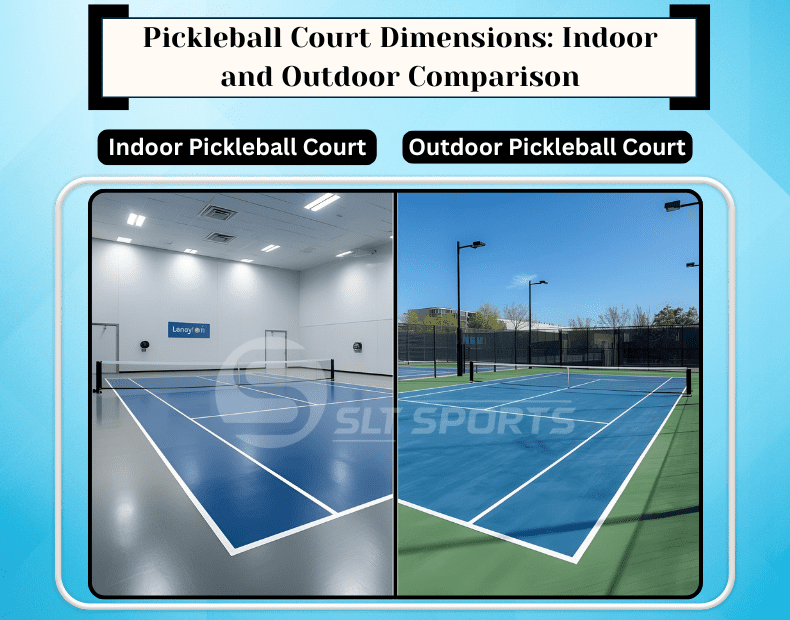
Are dimensions different?
Official pickleball court dimensions have to be the same for both indoor and outdoor environments – they just are, and it means you can play anywhere without worrying about the location.
What changes instead?
- Surface material- Indoor courts tend to be a bit smoother than their outdoor counterparts, while anyone putting up an outdoor pickleball court is going to need a more durable pickleball court surface to hold up to weather and keep a good grip.
- Lighting design- Indoor court lighting is all about being even, while outdoor courts use posts to support the pickleball court installation and make sure people can play safely in the dark.
- Drainage system (outdoor)-If you’re building an outdoor court, you’ll need to make sure it’s got a good slope and drainage to stop water from causing damage and making the pickleball court floor fall to bits.
- Coating thickness and UV protection- Outdoor pickleball court flooring needs to be able to handle heat and the elements – you’re going to need a bit more acrylic and a good layer of UV protection to keep it looking good for years to come.
Why Synthetic Acrylic Flooring Is Ideal for Pickleball Courts in India?
In India, where it gets pretty hot and the weather can be pretty wild, a lot of people favor outdoor synthetic acrylic flooring for their pickleball courts. And it’s not hard to see why – it lets them stick to standard dimensions, but still perform well even in tough conditions. For India, outdoor synthetic acrylic flooring is the go to choice – and for good reason:
- Heat resistance- Acrylic surfaces don’t hold heat like some other materials do, so they stay playable even when the sun is beating down on the pickleball court floor.
- Anti-slip texture- A textured acrylic coating gives you a consistent grip, making it safer and easier to control your game on an outdoor pickleball court.
- Monsoon durability- With the right install, an acrylic system is going to resist moisture and peeling, making it a great choice for places where the rain can get pretty intense – and also for long-lasting pickleball court construction.
- Lower maintenance compared to modular tiles- Acrylic courts require fewer repairs and are a lot easier to clean than some of the other options out there – so they end up saving you a pretty penny in the long run on pickleball court maintenance and operating costs.
Can a Pickleball Court Fit Inside a Tennis Court?
Yes, lots of pickleball courts are built right into existing tennis courts. That way, you get to make the most of your space while keeping the official pickleball court dimensions intact. Standard Tennis Court Size.
- 36 ft × 78 ft (doubles)- A regulation tennis court already has plenty of room to fit in a few pickleball layouts, so you don’t have to mess with the base surface.
How Many Pickleball Courts Fit?
- 2 courts (side by side) comfortably- Two courts side by side work really well – you should be able to get two clear courts in there, which makes for smooth play and a job well done on the pickleball court installation.
- Up to 4 courts with careful line planning- Up to four courts depending on how you draw the lines and use some colour coding – yes, four courts can actually fit in there, which is why this conversion is so popular in pickleball court construction projects.
This is a pretty popular approach with clubs and societies that want to turn underutilised tennis courts into spaces that can host a number of different sports, using acrylic resurfacing systems.
Pickleball Court Dimensions for Small or Compact Spaces
Urban projects are often stuck with limited space, especially in residential areas or on rooftops. But with a bit of clever planning, you can get a pickleball court in there while still following the standard dimensions.
Minimum Acceptable Size
- Playing area: The playing area has to stay 20 ft × 44 ft – that’s the bare minimum to make sure the game plays right and the lines are in the right place during pickleball court installation.
- Reduced run-off: 4–5 ft (only for recreational use) if you’re not doing competitive play, you can get away with a smaller clearance zone, which helps keep costs down in backyard court buildings.
While pro tournaments need full clearance, compact courts are perfect for:
- Private homes- having a court out back makes it so much easier to get in a game and makes building a pickleball court in your backyard a practical option for homeowners.
- Rooftop installations- Install lightweight pickleball court flooring and plan the layout carefully to ensure safety.
- Recreational clubs- clubs often go for compact layouts to balance the need for playability, with keeping costs down and making sure the pickleball court construction goes smoothly.
In those cases, cushioned acrylic systems can help reduce the impact on your joints and make up for the lack of space to move around.
Synthetic Acrylic Flooring and Court Dimensions
Synthetic acrylic flooring systems work seamlessly with standard court dimensions.
They help keep the dimensions accurate and deliver consistent performance on both residential and commercial installations.
Benefits
- Uniform thickness across the playing area – Even layer thickness across the whole court, So the ball bounces and grips the pickleball court surface evenly.
- Seamless integration with line markings- Acrylic systems let you get the line markings just right, without messing up the official pickleball court dimensions.
- Custom color zoning without affecting measurements – Making it easy to define the zones clearly on the court, while keeping the layout and playability just right.
- Adaptable to single or multi-court layouts – Acrylic flooring is super easy to get working on one or ten courts, making it the perfect choice for all of your pickleball court construction projects.
Whether you are building one court or ten, acrylic systems will keep the dimensions accurate across all installations.
Pickleball Court Dimensions for Commercial Projects
To make your pickleball court a success, you need to put some serious thought into the planning. Professional designs follow the official dimensions to ensure that your court is both safe and durable – and it’ll stay that way for a long time.
Best Practices
- Full run-off clearance – You can’t stress enough the importance of having enough space for players to move around. Adequate clearance is a must for high-intensity play on a top-notch pickleball court.
- Standardized court orientation – You want to set your court up so that it’s facing the right direction. This helps cut down on glare and wind, which can really make a difference when you’re trying to play ball.
- Consistent spacing between multiple courts – If you’re building more than one court, make sure you’ve got enough space between them. This will prevent games getting in the way of each other and make maintenance a whole lot simpler
- Dedicated walkways and seating zones – You want to make sure that spectators have a good view of the action, without being in the way. And don’t forget to protect your pickleball court from unnecessary wear and tear.
This is all about making sure that your court is easy to use, tournament ready and a great addition to your overall facility.
Common Dimension Mistakes to Avoid
- Ignoring run-off space – Don’t Forget About Clearing Space – If you don’t leave enough room for players to move around, you increase the risk of injury and that can be costly later on.
- Incorrect kitchen depth – If this is done incorrectly, it disrupts gameplay and affects player experience. And then you’ve got to start all over again – not good.
- Uneven baselines –The Baselines Need to be Level – If they’re not, players will have an uneven game – and that’s not what you want.
- Improper net center height – Getting the Net Height Right – If it’s not right you’ll be altering the whole game – and that’s not what you want.
- Mixing tennis and pickleball lines without clarity- It’s just too confusing to have both tennis and pickleball lines on the court. It makes the game harder to play – and harder to fix if something goes wrong.
Make sure you avoid all of these common mistakes – it saves you a bunch of money in the long run.
Conclusion
Making a great pickleball court starts with getting the dimensions right. And when you pair that with a top-notch synthetic acrylic flooring system, you can rest assured that you’ve got a court that will give you years of trouble-free play. Whether you’re building a residential court, a facility for your academy or a brand new commercial court, following the official dimensions is a must – it’s the only way to be sure that your court will give you years of great play.
Frequently Asked Questions:
A pickleball court is a 20 x 44 kind of deal, and that’s true whether you’re playing singles or doubles, don’t let anyone tell you otherwise.
And if you want to throw in some extra space for players to get around, you’re talking at least a 30 x 60 kind of setup.
Yeah, same deal indoors as it is outdoors: dimensions don’t change, just how you lay the floor and what kind of materials you use might be different.
The “kitchen” – or non-volley zone, for the newbies out there – starts a good 7 feet out from the net on either side.
Now if you want the perfect floor for a pickleball court, you can’t go wrong with some synthetic acrylic. It’s got the right amount of grip, it’s super durable, and it’ll still look good after a rainstorm.