
Building a tennis court in Delhi is a lot more than just a construction project – it’s a material choice, especially when it comes to tennis court flooring in Delhi. The city has some pretty extreme summers, and for good reason, it also has high levels of dust in the air, pollution, and – at least during certain times of the year – a lot of moisture from the monsoon, which all takes its toll on outdoor sports surfaces. As a result, many tennis courts start to show their age – losing grip, fading, or cracking prematurely despite the underlying foundations seeming sound.
That’s why, for experienced professionals in this line of work, & institutions are now placing less emphasis on who’s building the court and far more on what tennis court floor material you’re using and how that holds up over time. For all sorts of tennis court projects around Delhi NCR, the surface material you choose is now the make-or-break decision when it comes to how a court performs & how long it will last.
Why Tennis Court Flooring Fails Early in Delhi?
Most of the tennis courts that start falling apart prematurely in Delhi are actually victims of surface-related problems more than anything else – the base is fine, but the surface itself is the weak link. Now, you’d be surprised at the common causes behind this:
- Not rated for Delhi’s extreme heat – Many flooring materials just aren’t built to last through blistering heat, so they end up softening, cracking or falling apart altogether. And in Delhi’s sweltering summer heat, that process happens a whole lot faster – which means a lot less life out of your court.
- Poor UV resistance – Prolonged exposure to blistering sunlight is just too much for some flooring materials. Even the weakest coatings can’t withstand it and the result is colour that fades fast, leaving you with a dull, uneven playing surface.
- Low resistance to dust and abrasion –The thing is, high foot traffic and dust and sand everywhere just grinds away at surface texture over time and reduces grip – making it a safety issue for players.
- Cannot withstand resurfacing cycles – We’ve all seen what happens when you use cheap coatings , they just don’t hang together during resurfacing. The surface peels or delaminates and before you know it you’re looking at big repair bills.
Now, as for the court dimensions and markings, those all follow the standard international guidelines set by the ITF – but the thing is, how long a court lasts all depends on the materials used. That’s where the expertise of a tennis court flooring manufacturer comes in.
The Role of a Tennis Court Flooring Material Manufacturer
SLT Sports isn’t a turnkey construction company – we’re just a manufacturer of tennis court flooring materials. And the thing is, most of the long-term problems in courts actually come from the surface systems rather than the builders. So, as a material-focused company, SLT Sports steps in to help by providing:
- Built for outdoor conditions – These synthetic acrylic systems though – they’re built tough, engineered to withstand the heat, the heavy rain and constant dust of the great outdoors. They keep on performing, keep on looking good even in the harshest of conditions.
- Complete system with defined specifications – Every single layer, from primer to topcoat – it’s all carefully specified, so you get consistent quality throughout. No mismatched products that fail at the seams.
- Proper application guidance for contractors – We’re walking contractors through the installation process, every step of the way. This means strong bonding, correct texture and a long, long life out of your court.
- Suitable for new courts and resurfacing – These materials will even out perform on existing courts as well as new ones. And when you do have to resurface, you can be sure they’ll stick, without any peeling or surface failure.
By taking care of the surface, we let the builders, institutions, and owners of the court keep control over the construction, and the court performs reliably for years to come.
Why Acrylic Flooring Stands Out For Tennis Courts in Delhi?
Across Delhi NCR, synthetic acrylic systems have been the go-to choice for outdoor tennis courts – and for good reason. While some folks might think that just slapping on a decorative paint or generic coat will do the trick, the truth is that acrylic flooring systems are specifically designed for the rigours of sports.
The benefits of acrylic are pretty clear:
- Stable ball bounce in extreme heat- The surface keeps a consistent hardness even when its absolutely boiling outside, meaning you can count on your balls reacting the same way all year round.
- Controlled grip without harsh abrasion – We’ve designed it so you get enough traction to move around safely without being too rough on your joints or your shoes. You get smooth starts and stops without the surface wearing down too fast.
- Strong resistance to UV and moisture changes – Our UV-stable coatings keep the colours from fading and the surface from breaking down even in direct sunlight. And when it comes to seasonal changes, the surface just takes it in stride without peeling or blistering.
- Resurface instead of replace – Instead of needing to rip out and replace the whole thing over time, you can just slap on a fresh layer. That saves you a ton on maintenance down the line.
And it’s not just here in Delhi – all over the world, acrylic sports flooring is the standard for hard courts. For our conditions here, acrylic isn’t a luxury – it’s just a must-have.
Tennis Court Flooring Is a System, Not a Single Coat
Some people still think that tennis court flooring is just a simple layer of paint to slap on top. But the truth is, all top-tier tennis courts rely on layered surface systems – where each layer does its own thing.
A typical acrylic tennis court flooring system looks like this:
- Primer for strong bonding – The primer is essential in making sure every layer sticks to the base the way it should. Without it, you can expect peeling and early coating failure.
- Resurfacer for a smooth surface – Smoothing out small cracks, bumps and surface unevenness is what the resurfacer is all about. This gets your court level and ready for games.
- Textured acrylic for grip and durability – When you’ve got textured acrylic layers, you get controlled traction for safe play, and your surface will be a lot more resistant to wear and tear.
- Special line marking material – Line marking paint is perfect for keeping your court lines looking clear and lasting long. It’s resistant to fading, wear and foot traffic so you won’t have to keep re-applying it all the time.
Skip or water down any of those layers, and you’ll be dealing with uneven play, early wear and tear, and a real headache when it comes time to resurface the whole thing. And let’s not forget how the concrete base is prepped, which also plays a huge role in how the surface performs.
Cushioned vs Non-Cushioned Flooring: Choosing Based on Use
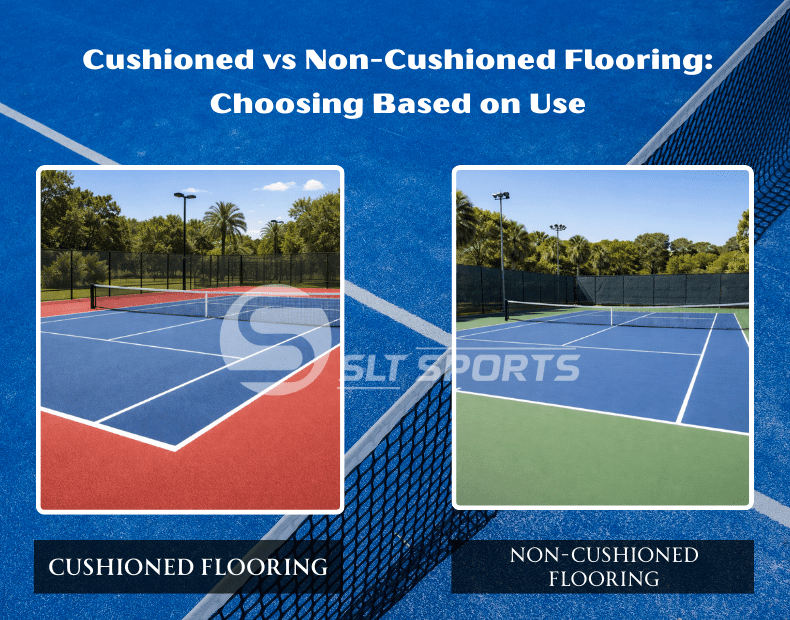
There is no one-size-fits-all solution for every tennis court – the choice all comes down to how you plan on using the thing.
Non-cushioned acrylic systems are often the go-to choice for:
- Schools and colleges – If you’re an institution where your courts get used pretty regularly but not all day long, this surface will do the trick. It can handle the day-to-day use without needing constant repairs.
- Residential tennis clubs – This is ideal for housing societies and private clubs with moderate play schedules. You get consistent performance without the need for high maintenance costs.
- Moderate-use courts – This is perfect for courts that get steady but not crazy amounts of foot traffic. You get a surface that’s durable, comfy and reasonably priced.
On the other hand, cushioned acrylic systems tend to be the way to go for:
- Training academies – Academies where the players are putting in the time and pushing themselves to the limit are going to love this surface. It supports high-performance play and consistent results.
- High-energy play environments – If you’ve got courts that are seeing a lot of fast-paced action and heavy foot traffic, this surface is designed to handle it. It keeps its grip, stability and durability even when things get intense.
- Extra joint protection needs – Cushioning your joints is what these layers are all about. They help absorb shock and reduce stress on your knees and ankles, making long practice sessions safer and more comfortable.
SLT Sports has both options available, so no matter what your needs are, you’ve got the freedom to choose the right court for you – rather than just following the latest trend.
Understanding Tennis Court Cost from a Material Perspective
People are always asking about tennis court cost, but the answers can be all over the map because the surface material you go with makes a huge difference. In fact, the material is typically the biggest single expense in the whole project – and it’s not just the upfront cost either, but the cost of keeping it maintained over time as well.
Now, while the total project cost is what gets most people’s attention, what really matters is the cost of the flooring material itself. Acrylic systems aren’t all the same – they differ in thickness, the way they’re layered, and even the texture of the surface. And all of that affects how long they’ll last and how often you’ll need to resurface them.
Picking the right surface to start with can end up saving you a lot of hassle down the line, extending the life of the court and lowering the overall cost in the long run – rather than just breaking the bank upfront.
Backyard and Residential Tennis Courts in Delhi
Interest in residential and backyard tennis courts is on the rise across Delhi NCR, particularly in those fancy farmhouses and villa developments where people can finally put their homes to good use. Unfortunately, most of these projects fall flat when they end up using some fancy decorative surface instead of a proper sports-grade system – just not the same!
Outdoor residential courts still have it rough:
- Direct sun exposure – Prolonged sunlight exposure can be tough on a tennis court’s surface. The constant barrage of UV rays starts to wear it down over time. And it’s not just a matter of looks – fading and surface breakdown can happen at an alarming rate if the materials aren’t up to scratch.
- Dust accumulation – Outdoor courts pick up dust and fine sand from their surroundings. This can be a real problem because it increases the likelihood of abrasion, reduces the grip of the surface, and just plain accelerates wear and tear.
- Seasonal moisture – Rain and high humidity lead to a constant cycle of wet and dry on the surface. And it’s a recipe for disaster – poor systems start to blister, peel, or just plain lose adhesion under these conditions.
A good quality, professional-grade acrylic flooring is really your best bet here – not only does it require minimal maintenance, but it also leaves the option open for redoing the court down the line if you need to.
Tennis Court Resurfacing and Renovation
No matter how well builders construct a tennis court, it will eventually need recoating or resurfacing. The difference between success and disaster all comes down to whether the original flooring system is compatible with the new coats of paint.
Acrylic-based systems are pretty hard to beat – they bond so well with new resurfacing layers, allow you to restore the texture so the court feels just right, and you can even just freshen up the colour without having to rip the whole thing apart.
Plenty of good advice exists on maintaining a tennis court—we supply the right materials to get it done right the first time.
About SLT Sports
SLT Sports is an Indian company that has made a name for itself specializing in some top-notch synthetic acrylic sports flooring materials, of which their tennis courts in outdoor settings are the real show-stoppers.
SLT Sports is all about:
- Making top-quality tennis court surfaces – Our focus is on getting you a durable, high-performance tennis court finish that will give you years of consistent play. We design every surface with that in mind.
- Flooring systems for new and existing courts – We develop complete systems for both new build projects and resurfacing work. Our goal is to ensure a reliable bond and uniform performance – no matter what the job is.
- Providing technical installation expertise – Our detailed guidance ensures contractors, institutions, and consultants apply every layer correctly. This reduces the likelihood of errors and gives you a more durable court in the end.
- Supporting contractors and project teams – We actively support our partners—contractors, institutions, and consultants—to ensure every project is done right.
Instead of trying to churn out complete courts from start to finish, SLT Sports focuses on getting you the material that’ll stand up to India’s tough climate and still leave your court looking and feeling its best.
Conclusion
In a city like Delhi, where extreme heat, dust, pollution, and seasonal moisture batter tennis courts, the flooring you choose boils longevity on the court down to one single thing. Time and time again, courts fail not because builders construct weak bases, but because the surface system cannot cope with these conditions in the first place.
Ditching the “build it fast, patch it up later” approach in favor of a material-first approach to tennis court flooring is a game-changer. By focusing on durability, playability and overall value for money, synthetic acrylic flooring systems have consistently delivered for Delhi NCR, providing a consistent bounce, reliable grip, UV resistance and the bonus of being able to resurface rather than replace the whole thing. When specified and applied as a complete system – not just slapping on some pretty colors for show – acrylic flooring becomes the rock-solid foundation of a court that just keeps on performing season after season.
Frequently Asked Questions:
We reckon synthetic acrylic flooring is the way to go – it does a great job of resisting heat, UV, and the dust that can wear a court down.
Nope. We make and supply court flooring materials and provide clear guidance to ensure proper installation.
Absolutely. It’s a great choice for resurfacing, as long as the foundation of the old court is in good nick.
Yes, you can do it, but you must consider how heavily users use the flooring. Some places where they don’t get that much play opt for non-cushioned systems, while the more high-intensive places go for cushioned options.
With the right materials and a bit of TLC, you can expect resurfacing every few years, depending on usage levels and weather exposure.