
Acrylic sports flooring is often treated as a single, uniform product. In reality, the Acrylic sports flooring – in theory, a single, uniform product, but in reality, it’s a whole different story. The term “acrylic flooring” covers a pretty broad spectrum of stuff – different material qualities, formulations, performance standards, the whole nine yards. Two courts can look like identical twins right off the bat, but within a few years of non-stop use, they’ll be worlds apart in terms of how well they perform.
This guide sets out to explain why not all acrylic floors are created equal, how to tell if you’re looking at a truly top-notch synthetic acrylic sports flooring material, and why choosing a manufacturer with some actual material expertise, like SLT Sport, can make all the difference between a floor that lasts and one that falls apart after a few years.
Why People Often Misunderstand Acrylic Sports Flooring?
One of the biggest cock-ups in sports flooring is the idea that the quality of an acrylic floor is mainly down to:
- Color finish
- Thickness alone
- Brand name
- Price per square foot
To be blunt, none of these factors tells you anything about how a floor will perform after a couple of years, five years, ten years – pick your number.
Many acrylic floor failures happen not because acrylic is wrong, but because the system is poorly built or mismatched to the environment.
Acrylic Sports Flooring Is a Performance System, Not a Paint
A top-notch synthetic acrylic sports floor is nothing like a coat of paint or some industrial coating. It’s a proper sports surface system, specifically designed to handle all the stresses that come with sports – player movement and impact, the way a ball bounces or a wheel interacts with the surface, heat expansion and contraction, moisture exposure, movement in the base, tiny cracks forming over time, and just general wear and tear.
Each layer in the system plays a role. If one layer is compromised, the whole thing falls apart.
The Core Difference: Formulation Over Finish
The key difference between mediocre and top-notch acrylic flooring revolves around how it’s made.
Resin Quality Matters More Than Thickness
Premium acrylic flooring is made with super-flexible, top-shelf polymer resins. This is what keeps it from cracking over time and gives it that extra life.
These are also super good at:
- bouncing back after impact, and not losing that spring
- handling UV sunlight without breaking down too fast
- sticking to the base really well
- and taking a pounding without losing its grip
Lower-end systems, on the other hand, usually rely too much on:
- cheap fillers that dilute the good stuff
- watered-down adhesives
- stiff, brittle plastics that crack up really easily
What looks cheaper upfront often costs more through early replacement.
Solid Content: The Hidden Indicator of Quality
Solid content is the amount of actual good stuff that sticks on the surface after it’s been applied.
When it comes to the best acrylic sports flooring:
- You need a product with decent, solid content number\
- It forms strong, flexible films\
- Keeps texture looking good\
- And stays looking good with a,ge too.
Low solid content products may look fine at first, but under heavy use, they:
- Start wearing thin fast
- lose their grip
- fade out and need recoating all the time
Texture Is Not Random — It Is Engineered
In acrylic sports flooring, texture is way more important than most people give it credit for. Texture in advanced sports flooring systems is engineered, not improvised, to provide safe and predictable play.
The texture of an acrylic sports floor is carefully engineered to control player reaction and movement. It decides just how much grip the shoe or skate wheel gets, how smooth or jerky the movement is, and what kind of safety margin players have when they’re stopping, turning, or changing direction. Even a tiny variation in texture can make a huge difference in how the court feels and performs.
How Engineered Texture Controls Performance and Player Safety?
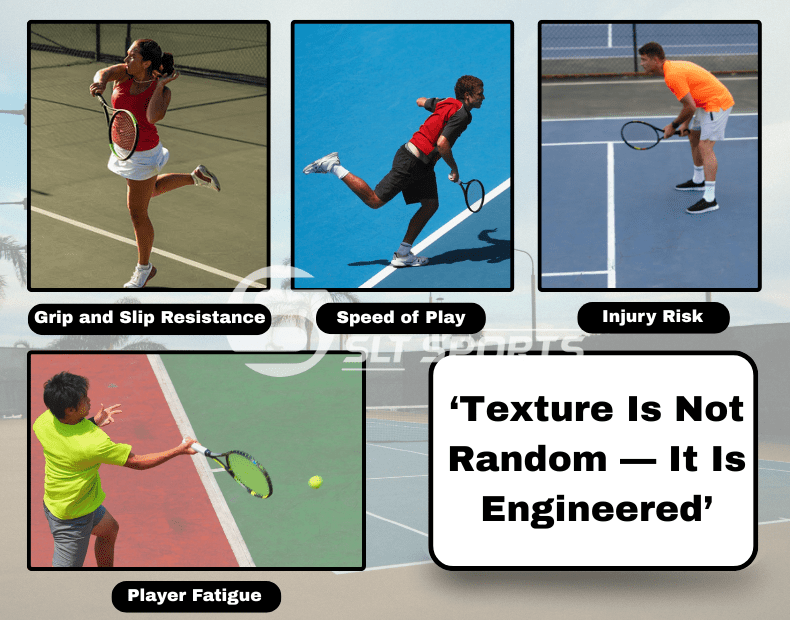
Texture has a big impact on the following performance factors:
Grip and Slip Resistance
Good texture has just the right amount of grip – enough to stop you from slipping, but not so much that the surface feels rough or abrasive. Too much grip and your joints are straining, too little and you’re taking a big risk of falling over.
Speed of Play
Texture decides just how fast or slow you feel on the surface. A good balance lets you move naturally with control, which is a must for consistent gameplay across the whole court.
Injury Risk
A poorly managed texture can lead to sudden stops or slips, which puts you at risk of getting ankle, knee, or muscle injuries. We want to reduce these sudden traction changes, not increase them.
Player Fatigue
Overly rough surfaces increase friction, forcing you to work a lot harder with every step. A more subtle texture reduces unnecessary drag, so you can keep going for longer without burning out.
To get this balance right, top-of-the-line sports flooring systems use graded silica aggregates. We carefully select aggregates based on size, shape, and hardness and apply them evenly within the acrylic coating for predictable, uniform performance.
This engineering means you get:
- Consistent grip across all areas – heavy use or light
- A predictable response every time you move
- Texture that stays consistent over the long haul
On the other hand, cheaper sports flooring systems are often a bit of a free-for-all, with:
- Using sand that’s not been washed properly
- Mixing aggregates in a pretty haphazard way
- Adjusting texture on the fly without testing it
These shortcuts lead to patchy grip, shiny patches, and uneven wear over time. What might feel fine at first often turns into an accident waiting to happen later on.
For premium sports flooring, texture is a key performance indicator – not just some cosmetic nicety. When engineered correctly, the court feels reliable, ages evenly, and remains safe throughout its lifespan.
Flexibility vs Softness: A Critical Distinction
Lots of people think a softer surface is generally always the best. But that’s just not true.
Top-of-the-line acrylic sports flooring is flexible enough to give a little, but still firm enough to support:
- Its ability to absorb all the tiny movements you make when you’re playing
- Reduced stress on your joints, which is especially important for athletes
- It maintains speed and control of the movement, so you can still get that top performance
But cheaper flooring often ends up being either too hard and therefore cracking and delaminating, or too soft and so you end up with drag, fatigue, and a surface that’s just not stable. Getting that perfect balance is all about material engineering and not cutting corners.
Climate Compatibility: Where Many Floors Fail
In countries like India, where the climate can be really harsh, sports flooring’s got to be able to handle:
- Sizzling surface temperatures
- Endless UV exposure
- Season after season, the area experiences heavy rain and pollution, followed by sudden temperature swings.
Premium acrylic flooring materials are specifically formulated to remain stable in these extreme conditions. They’re less likely to go chalky, brittle, or have their pigments break down.
Lower-grade systems often fail within a few seasons because they aren’t designed for the local climate.
Base Protection Is a Sign of Premium Flooring
What makes acrylic flooring great is that it shouldn’t just perform well on top – it should also look after what’s underneath
Premium systems:
- Seal the base against moisture, which keeps it in great condition
- Stop cracks from reflecting up onto the surface
- Reduce the wear and tear on the base
This keeps the concrete or asphalt slab itself for a whole lot longer
If the base does start to fail, resurfacing can be a costly, disruptive process – so getting a premium material helps delay or even prevent this problem altogether
Why Cheap Acrylic Floors Age Poorly?
Acrylic flooring doesn’t just go bad overnight – inferior products will show you the warning signs over time:
- After a while, the texture just kind of fades in areas that get a lot of use
- The surface starts to get all polished and slippery – making it harder to get a good grip
- Tiny cracks start to show up everywhere, and they can quickly turn into full-on damage
- The color begins to fade, leaving behind a chalky residue.
- And let’s not forget when the ball just won’t bounce right, or the skating surface gets all sketchy
Most of the time, it’s not the installation that’s the problem; it’s actually the quality of the material itself.
Premium Acrylic Flooring Ages Predictably
The one big benefit of getting your hands on a really good synthetic acrylic sports floor is that it lasts just as long as you’d expect it to
Premium systems last a long time and stay that way basically because they:
- Wear down evenly so you can schedule regular maintenance
- Respond super well to resurfacing
- Don’t just totally fall apart all of a sudden
This is massively important for places like schools, clubs, or even big commercial facilities that can’t afford to shut down even for a day.
Why Manufacturer Expertise Matters More Than Product Labels?
The quality of an acrylic floor depends completely on who manufactures it.
An experienced team making the flooring knows a thing or two about:
- How materials act up after years of being under the sun
- How different layering systems play nicely with each other
- What formulation actually works in real life
- How the climate & usage patterns affect how fast it all wears down
Generic resellers and short-term suppliers can’t replicate this level of performance.
How SLT Sports Approaches Premium Acrylic Flooring?
SLT Sports puts the materials first when it comes to making premium synthetic acrylic flooring. Every single decision is based on figuring out what is going to make it last and perform well, rather than just looking good on paper.
So what does SLT Sports look for in a top-class system? Well,h they want:
- A resin blend engineered to perform in your climate.
- A controlled amount of solid content so it stays stable.
- Texture systems engineered for controlled grip and safety.
- Each layer is tested to ensure the system works as one.
- And on top of that, a system that will still look good even after years of resurfacing
SLT Sports provides top-grade acrylic flooring systems for:
- Tennis courts
- Basketball courts
- Badminton courts
- Pickleball courts
- Skating rinks
- And just about any other multi-purpose sports facility you can think of
Each system delivers consistent performance in real-world use, not just on inspection day.
Premium Acrylic Flooring vs Average Systems
| Aspect | Premium Acrylic Flooring | Average Acrylic Flooring |
| Resin Quality | High-grade, flexible polymers | Rigid or diluted binders |
| Texture | Engineered & consistent | Irregular & uneven |
| UV Resistance | High | Low |
| Aging | Predictable | Unstable |
| Maintenance | Planned & minimal | Frequent & reactive |
| Lifespan | 10–15+ years | 3–6 years |
Industry Perspective on Surface Quality
The world always stresses how much having a consistent and durable surface matters. The International Tennis Federation (ITF) makes this point clear – what really matters is how well a court behaves over time, in terms of its stability, and how it holds up under repeated play.
Check out some of ITF’s recommendations at https://www.itftennis.com
Conclusion
When it comes to sports flooring, people get all caught up on how a court looks brand new – but that means nothing if it falls apart a year later. To take your game to the next level, you need to focus on the real stuff – the actual material of the court, and how it’ll hold up after years of use & heavy use. With this mindset, you’ll be able to move way beyond superficial considerations and get yourself a system that will really last the distance.
Premium synthetic acrylic sports flooring materials from the likes of SLT Sports deliver a few key benefits:
- a safer playing surface
- a much longer service life
- lower maintenance costs over the long run
- better, more consistent performance
And it’s exactly this difference that sets a mid-pack court apart from one that’s going to stay reliable.
Frequently Asked Questions:
No way. They’re all quite different, from the kind of resin they use to their consistency and durability.
Well, look for some obvious signs like consistent texture, strong bonding, UV resistance, predictable wear, and experience from the manufacturer.
Generally, you can expect 10-15 years or more, depending on how well it’s put in and kept up.
Yeah, premium systems are designed to handle whatever the elements throw at them – heat, rain, UV exposure, and all the rest.
The thing is, material behavior over time is all about what you know about the formulation, what kind of testing you’ve done, and what kind of real-world experience you have.
SLT Sports puts its focus on designing materials that really last the distance, not just looking pretty for a while.