
For many householders, the notion of installing a pickleball court starts off as a fairly straightforward way to upgrade their lifestyle – a way to stay active, bring the family together or finally make use of that unused outdoor space. But when you start getting down to planning, it quickly dawns on you that a residential pickleball court construction isn’t just a matter of painting some lines on the concrete.
Unlike sports facilities you see at public parks, home courts have to balance out performance, safety, how good they look, how quiet you can keep them, how low the maintenance will be & how well it’ll hold up over the long term – all while trying to fit in with your day-to-day household routine. A court that’s perfect on move-in day but starts to get slippery, cracked or noisy within a few years – that can go from being a fun feature to a right old nuisance.
This guide breaks down what we think homeowners need to know before they even start a residential pickleball court construction – with a focus on smart forward thinking, surface behavior, the quality of the materials used and why synthetic acrylic flooring systems from SLT Sports are turning out to be a more and more popular choice for home use.
Start With Lifestyle, Not Just Court Dimensions
Most home pickleball courts aren’t built with tournaments in mind – they are built for casual, everyday use. That needs to influence every single design decision.
Homeowners need to ask themselves:
- Who is going to use the court most – the kids, the adults or Granny?
- Is it going to be used every single day or just a few times a week?
- Is the primary goal fitness, socialising or just having fun?
- Will the court be a multi-purpose area?
Getting the answers to those questions early on is the best way to avoid either over- or underbuilding the surface.
Space Planning Goes Beyond the Playing Area
While the official pickleball court size is 20 × 44 feet, the real challenge is creating a backyard setup that works for your whole family – and your neighbours.
Key residential space considerations:
- Safe entry and exit zones
Players need some room to get in and out of the court without worrying about colliding with others. Having a dedicated entry and exit zone reduces the risk of accidents, especially when grandma or the kids are playing. Plus, it keeps things safe for folks who are tired of lugging their gear.
- Seating or resting areas
Residential pickleball court construction is often a social thing you do in short bursts. Having somewhere to sit, rest your legs and grab a drink makes it a lot more enjoyable. And it stops people from sitting on the court edges, which can damage the surface and leave you with a real mess on your hands.
- Nearby landscaping and walls
The walls, fences, trees and planters around your court will have a big impact on play and safety. Get too close to hard surfaces, and you increase the risk of injury. And avoid planting things that will grow into the court or clog up the drainage system.
- Drainage flow around the court
You want water to flow away from the court, not towards it. If it doesn’t, you’ll end up with a mess on your hands – standing water, staining, algae growth – the lot. Planning the slope and drainage around your court will keep it usable even when it’s pouring down.
- Visual balance with the home
The last thing you want is a court that sticks out like a sore thumb. Think about how you can use colour, placement and spacing to make the court fit in with the rest of your property. That way, you can enjoy the benefits of playing pickleball without ruining the look of your home.
If your court feels cramped or intrusive, it’ll never be as much fun to play.
Privacy and Neighbour Sensitivity Matter
One of the things that gets overlooked when building a residential pickleball court is how it’s going to affect your neighbours.
Homeowners should think about:
- How far is the court from the neighbours
- How tall and where are you putting the fence
- How sound will bounce off the walls or buildings
- When and how you play
By taking a bit of time to think about the impact of your court on those around you, you can avoid any potential problems and build a long-lasting backyard setup that everyone can enjoy.
Base Construction: Residential Mistakes to Avoid
In a residential project, base construction is where money-saving shortcuts all too often get taken. And that’s usually where the long-term problems start to rear their ugly heads.
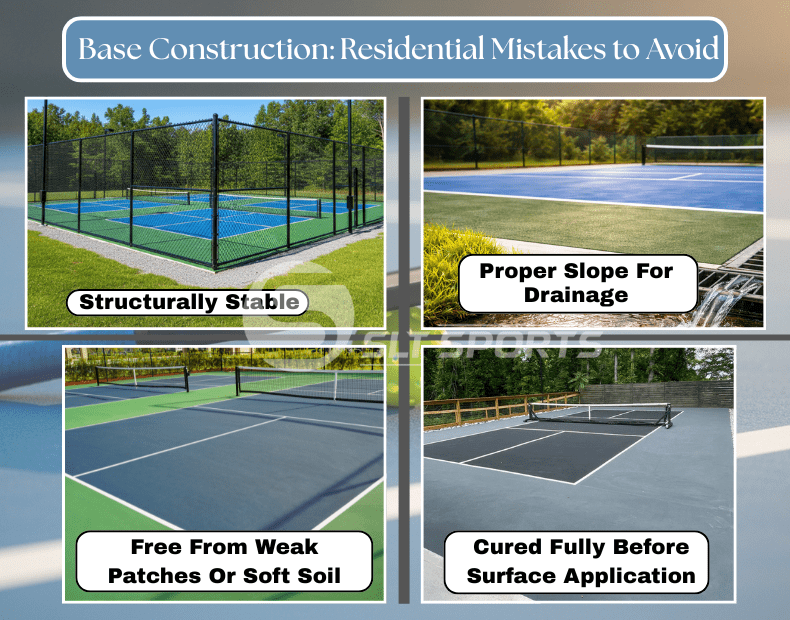
A residential pickleball court construction base needs to:
- Be structurally stable
It’s got to be strong enough to handle all the comings and goings of the players and daily use without shifting or settling. A solid base keeps the court from cracking, developing uneven spots, or deforming over time. If the base isn’t stable, a whole host of problems will develop, including early surface failure, even if you’ve used top-quality flooring materials.
- Have a proper slope for drainage.
You need a gentle slope to allow rainwater to flow off the court. Without one, water’ll start pooling on the surface, making it slippery and speeding up the wear and tear. And good drainage also protects the base from water damage and extends the life of the court.
- Be free from weak patches or soft soil.
Any areas that are weak or poorly packed can start sinking or cracking down the line. These soft spots put uneven pressure on the surface, which can lead to premature damage. It’s crucial to make sure the whole area is solidly compacted for consistent results.
- Be cured fully before surface application
Concrete bases need to be given enough time to cure and get strong before you apply the acrylic surface. If you put it on too soon, you’ll trap moisture in there and weaken the bond. Eventually, that’ll cause peeling or cracking of the pickleball court surface. Proper curing is essential for strong adhesion and long-lasting results.
Even the best surface material won’t save a badly built base by itself.
Why Surface Choice Defines the Homeowner Experience?
When it comes to residential courts, surface feel is way more important than speed. Home players want to feel comfortable, safe, and be able to predict what’s going to happen – not be thrown into a pro-level environment.
Which flooring suits residential pickleball court construction?
Synthetic acrylic pickleball court surfaces offer:
- A grip that’s controlled just right for casual players
- A seamless finish with no annoying joints
- Less stress on the joints
- Stable performance all year round
- A clean, modern look
Unlike tiles, stone, or fancy coatings, acrylic systems are specifically designed to handle movement on a sports court.
Texture Balance: A Residential Priority
In residential homes, pickleball courts usually end up being played on by:
- Barely trained players
- Seniors with limited mobility
- Children learning movement
This makes getting texture balance right an absolute must. You don’t want your residential court to be:
- Overly rough surfaces that cause fatigue
- Overly smooth finishes that increase slip risk
Premium synthetic acrylic systems get this right with smart texture engineering – the surface feels amazing to play on, and it’s still totally safe.
Heat Management in Home Courts
A lot of homeowners underestimate just how scorching a court surface can get in the summer months.
Making the wrong surface choice can make for some pretty uncomfortable playing conditions:
- The court gets so hot that you don’t want to play on it
- The sun beats down & sends heat towards the house
- The surface just starts breaking down
Synthetic acrylic flooring helps out with that by offering:
- Lighter colour options to reflect the sun’s rays
- The ability to play steadily, even when the temperature is fluctuating
- A much smoother, less brittle surface over time
Drainage: The Silent Performance Factor
Residential courts, whether they’re incorporated into a garden, driveway, or patio, all share a common issue when it comes to drainage. When that drainage goes wrong, you get:
- Pooling water that just sits there
- Unwanted staining on the surface
- Wear and tear that’s happening way faster than it should
- Slippery conditions and algae growth
Acrylic pickleball courts are designed to work in harmony with proper slope and drainage planning, so no matter how much rain comes down, the surface stays usable.
Maintenance Reality for Homeowners
For many homeowners, the key selling point of synthetic acrylic pickleball courts is how ridiculously easy they are to maintain.
With an acrylic system, you get:
- No watering required – just forget about it
- You don’t need to worry about rolling or grooming the surface
- Tiles won’t need replacing anytime soon
- And no need to repaint every few months
Maintenance is a doddle and only needs to happen infrequently – perfect for families on the go.
Visual Integration With the Property
When it comes to residential pickleball court construction, the idea is to make it fit in with the rest of the place, not look like some bolted-on sports facility.
Synthetic acrylic courts let you:
- Choose from a range of custom colours
- Add some softness to the design with a gentle approach
- Keep the line markings simple and understated
- Tweak the layout to make it multi-use
That way, the court blends in seamlessly with country villas, farmhouses and all sorts of landscaped properties.
Long-Term Usability vs Short-Term Savings
Homeowners often get caught up in comparing costs upfront, but to be honest, the right comparison is all about long-term usability.
Cheaper surfaces might:
- Need constant repair work
- Lose their grip quickly
- Start to fade and crack
- Be out of commission in just a few years
Premium acrylic systems might cost more to start with, but they deliver years of reliable service with minimal disruption.
Why SLT Sports Is Suited for Residential Pickleball Courts?
SLT Sports specialises in synthetic acrylic sports flooring systems that are designed to withstand the real world, not just look good.
For residential pickleball courts, SLT Sports offers:
- Acrylic formulations that are tailored to individual climates
- Texture systems that are carefully controlled
- Long-lasting surfaces that keep on performing
- Low maintenance performance that’s easy to live with
- Expert guidance to help you get your home project just right
The focus is all about comfort, durability and consistency – the things that really matter to homeowners.
Industry Reference for Pickleball Court Planning
When it comes to building a pickleball court at home, having the right guidance is key to making sure you end up with a space that’s fun to play in and safe for everyone.
One good place to start is to look at the official pickleball guidelines in the US, which can be found here – It.
Common Residential Pickleball Court Mistakes
- You can’t just ignore the fact that your new court has a very close neighbour – that could get messy fast.
- Don’t go for a fancy paint job; good quality sports flooring is what really matters.
- Don’t skip the part about making sure water drains properly, or your court will be a mess within weeks.
- You don’t want to overdo it with the texture – that can be a nasty shock on the joints.
- Commercial projects are not suitable for residential use – that extra expense is not worth the hassle.
Staying away from these common mistakes means that your new court will be a real plus in your home, not a source of stress.
Conclusion
A well-planned pickleball court at home should enhance your life – not create problems or require endless maintenance. When you build with the best materials and make some smart choices about the design and construction, you can end up with a court that stays fun to use for many years to come. At SLT Sports, we specialize in building pickleball courts that deliver that kind of long-term satisfaction.
Frequently Asked Questions:
Absolutely, pickleball is a low-impact sport that’s perfect for people of all ages and works really well with a home setup.
Hands down, synthetic acrylic flooring is the go-to choice for home courts. It’s safe, comfortable, low-maintenance and lasts a very long time.
Yes, you can; acrylic surfaces are perfectly weather-resistant and will function great in the Indian heat.
If you build it and look after it, a well-made acrylic court will last anywhere from 10 to 15 years – or longer if you look after it.
Not a bit, with an acrylic court, you’ll find that maintenance is pretty minimal – and super predictable.
At SLT Sports, we’re all about designing and building acrylic court systems that are perfect for the home environment – so you can enjoy your pickleball for years to come.