
This article is going to break down the differences between indoor and outdoor pickleball court surface and do a side-by-side comparison of the good and the bad points of each. And then, we’ll tell you why outdoor pickleball courts are becoming the way to go, especially when you use a top-notch surface system when building them.
At first glance, indoor courts seem like the obvious winner because they get to skip all the weather & control the environment 100%. But, if you really start to think about it and consider the actual needs of players, outdoor pickleball courts are a way more sensible choice.
1. Understanding Indoor and Outdoor Pickleball Courts
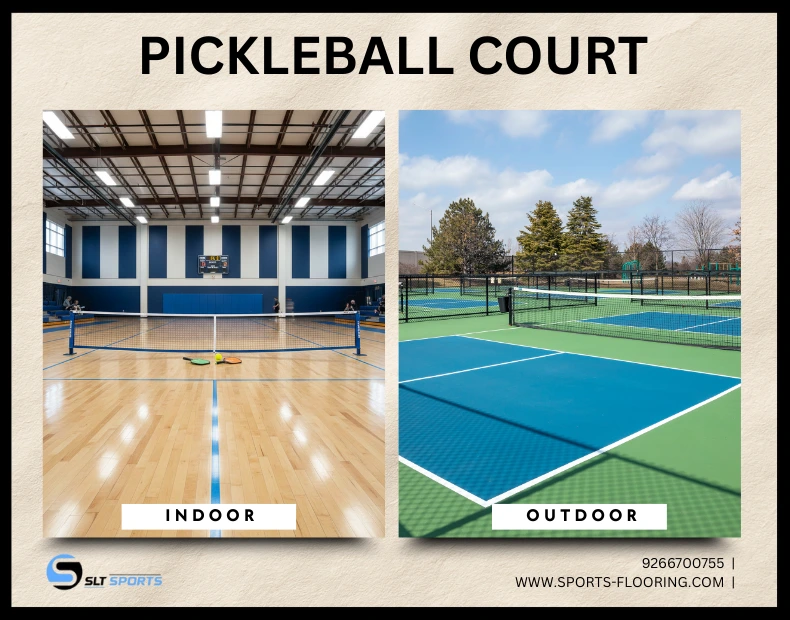
Indoor Pickleball Court
An indoor pickleball court gets built inside a place like a sports hall, gym, school auditorium, or some kind of general-purpose indoor space. These courts are safely tucked away from the weather, and they often have to share the space with other indoor sports.
Indoor courts usually make do with flooring systems or multi-use surfaces that aren’t necessarily designed specifically for pickleball, let alone the way the ball behaves on those surfaces.
Outdoor Pickleball Courts – Fresh Air and Open Spaces
If the court is in the open, you’ve got an outdoor pickleball court, typically built on a concrete or asphalt base with a special sports surface laid on top. These courts are built to withstand the weather and the shifts in temperature, and they get used a lot.
Outdoor courts are designed with a few key things in mind: drainage, the way the surface feels under your feet, and making sure it won’t break down too fast under the sun.
2. Flooring Systems – Indoors vs Outdoors
Indoor Flooring – What’s Available
For indoor pickleball courts, you’ve got a few options available:
- Wooden sports floors
- Synthetic PVC or vinyl systems
- Multipurpose indoor sports flooring
- Temporary court markings on existing floors
To be honest, when it comes to playing your absolute best, these surfaces can be a source of some problems, particularly grip and how the ball bounces off them.
Outdoor Flooring – Built to Last
Outdoor pickleball courts, on the other hand, are used:
- Concrete or asphalt base
- Synthetic acrylic sports flooring system
- Textured, non-slip top layers
- UV- and weather-resistant coatings
These floors are specifically made for outdoor sports, rather than just getting stuck on top of something that was there before.
3. Grip, Movement, and Player Safety
Movement Demands in Pickleball
Pickleball’s got a lot going on: fast speed changes, sudden stops, and a non-stop forward-backward shifts in the kitchen. Plus, the flooring has to support it all without anyone slipping up or putting too much strain on their joints.
Indoor Flooring Performance
Indoor flooring can be a problem because it’s:
- Too smooth, increasing slip risk
- Inconsistent across areas due to wear or shared usage
- Dependent on footwear and humidity levels
A lot of indoor courts are multi-purpose, so the surface isn’t really designed to provide the right amount of grip for pickleball.
Outdoor Flooring Performance
Outdoor pickleball courts are a different story altogether. The surface is actually designed with grip control in mind and texture that’s carefully crafted to give you predictable traction, which means you get:
- Provide predictable traction
- Reduce slipping during lateral movement.
- Support confident footwork in all playing zones.
This consistency is one of the main reasons why outdoor courts feel so much more reliable under competitive play.
4. Ball Bounce and Game Consistency
Ball Behaviour on Indoor Courts
The ball behaves a lot differently on indoor courts because of things like:
- Flexible or cushioned floors
- Jointed or modular systems
- Surface wear from other sports
This can really make a difference, especially if you’re an outdoor player.
Outdoor Courts
Outdoor courts built on solid foundations give you a consistent and reliable bounce all over the place. This is really important for:
- Fair gameplay
- Skill development
- Competitive matches
In a coaching or serious playing environment, this consistency is way more important than even having perfect climate control.
5. Weather, Environment, & Real-World Usage
Indoor Courts – Good, Bad & Limitations
Indoor courts are a lifesaver on bad weather days, but they come with some not-so-ideal drawbacks:
- High construction and infrastructure costs
- Limited availability and booking conflicts
- Restricted scalability due to building size
They do work well for locations with some extreme weather or where there’s already a facility in place, though.
Outdoor Courts: Built to Thrive in the Weather
It’s worth pointing out that outdoor courts aren’t just built to weather the storm; they’re actually designed to make the most of it. Get the design right, with decent drainage and surface systems in place, and you end up with courts that can handle all sorts of conditions:
- Handle heat, rain, and UV exposure
- Dry quickly after rainfall.
- Remain playable for most of the year.
In fact, in India, for instance, the outdoor courts can end up with more usable hours per year than their indoor counterparts.
6. Space Availability and Scalability
Indoor Space Constraints – The Problem
Indoor pickleball courts need a big space with high ceilings, decent lighting, and proper ventilation. Which in turn limits things like:
- Number of courts per location
- Expansion possibilities
- Cost efficiency per court
Outdoor Courts Make it Easier to Grow.
Outdoor pickleball courts are way easier to:
- Add in phases
- Integrate into parks, schools, and societies.
- Convert from or combine with other outdoor sports courts
For clubs and communities, having an outdoor court is a super smart way to future-proof your setup without being tied to some cramped, expensive building.
7. Construction Cost, Long-Term Value & Return on Investment
Indoor Pickleball Court Costs – Things to Consider
You’ll need to factor in:
- Building or modifying structures
- HVAC and lighting systems
- Specialised indoor flooring
- Higher ongoing operational costs
Outdoor Pickleball Court Cost – A More Efficient Option
Outdoor pickleball court construction cost can be a more cost-effective choice because:
- Lower construction cost per court
- Minimal operational expenses
- Easier maintenance and resurfacing
And from a long-term perspective, outdoor courts are a better bet for return on investment – especially if you’re planning a multi-court facility.
8. Maintenance & Lifespan of a Pickleball Court
Maintaining Indoor Flooring
Indoor flooring can be a bit high maintenance because it’s sensitive to:
- Moisture and humidity
- Footwear restrictions
- Surface damage from non-sport usage
This can mean you’ll need to shut down the facility at some point to do repairs.
Easy Maintenance for Outdoor Pickleball Courts
Outdoor acrylic pickleball courts are actually low-maintenance:
- Easy to clean
- Simple to inspect
- Renewable through resurfacing
Instead of replacing the entire system, performance can be restored with surface renewal, extending the court’s life significantly.
9: Indoor vs Outdoor Pickleball Courts: Which Is Better?
When Indoor Courts Make Any Sense
Indoor pickleball courts might be a better option when:
- You already have some space lying around
- The weather outside is bad
- You’re not planning on playing that often
Why Outdoor Pickleball Courts Usually Win Out
What you get with an outdoor pickleball court surface:
- A playing experience that’s consistent as the day is long
- A court that can grow with your needs
- Cheaper in the long run
- Easy to keep in good shape
- Way more accessible for neighbourhood communities and clubs
For the most part, schools, clubs, and public facilities will find that outdoor courts give them the best of both worlds.
SLT Sports Perspective on Pickleball Court Surface
At SLT Sports, when we build an outdoor pickleball court, we’re talking about making it last through the Indian heat and rain. That means our focus isn’t just on fitting the turf down, but on:
- Making them last a lifetime
- Keeping players safe
- Making sure the court plays well
- Easy to clean
And when you get that right, you end up with a pickleball court that becomes a real workhorse, not just for the first few months, but for years to come.
Conclusion
Indoor pickleball courts have their fans; don’t get us wrong. But when you really weigh up performance, scalability, cost-effectiveness, and long-term usability, outdoor pickleball court surface stand out as the better bet for most projects.
With the right construction techniques and a surface system that won’t let you down, outdoor pickleball courts deliver consistent play, lower maintenance, and more bang for your buck over time. That’s why they’re the preferred choice for savvy pickleball infrastructure planners.
Frequently Asked Questions
Yes. When built with a proper acrylic sports surface, outdoor courts provide excellent grip and controlled movement.
With correct base preparation and maintenance, outdoor pickleball courts last many years and can be renewed through resurfacing.
In most regions of India, outdoor courts remain usable for the majority of the year, especially with proper drainage and surface design.
Not necessarily. Beginners often feel more confident on outdoor courts due to the predictable grip and bounce.