
At first glance, badminton may appear to be just a simple game, but beneath the surface, you’ll find a sport that demands accuracy, speed, and movement that seems almost too smooth. To perform at your best as a player and deliver maximum value for the facility, every inch of the badminton court dimensions must be planned with precision.
SLT Sports’ badminton court flooring is built with one thing in mind: reliability. Every measurement, line, and flooring layer works together to ensure a fair game where player skill, not flooring or markings, decides the outcome. In this guide, we take a closer look at the specifications that really make a difference when it comes to building a badminton court that’s going to meet the standards.
Standard Badminton Court Dimensions: What You Need to Know
The size of a badminton court is defined by international rules, and they’re the same regardless of whether you’re playing in a competition or just warming up.
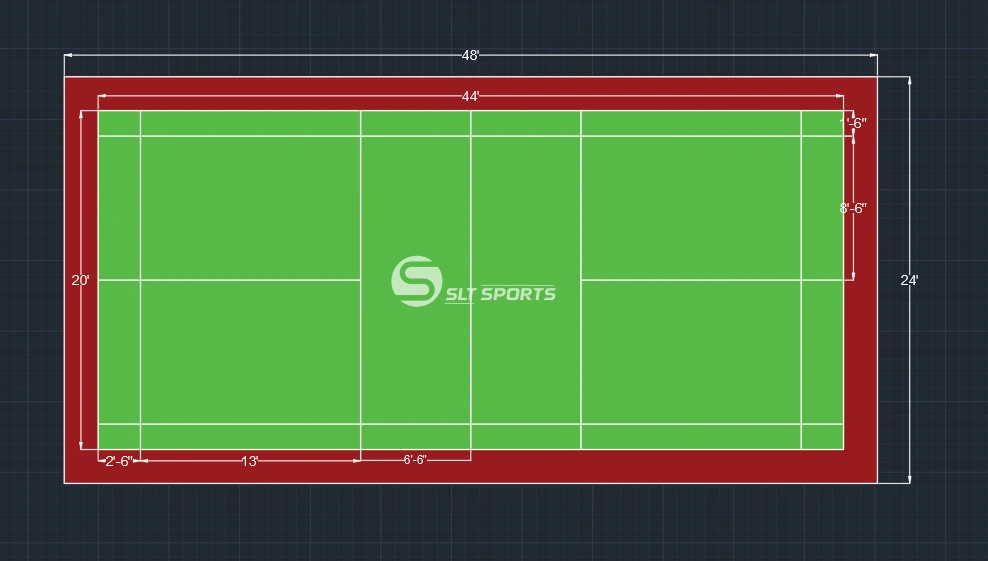
The Overall Court Size: The Basics
- Length: 13.40 metres
- Width (Doubles): 6.10 metres
- Width (Singles): 5.18 metres
These measurements will apply no matter whether your court is housed indoors or out, provided the surface and line markings are up to the standard of the course.
Singles vs Doubles: The Differences That Matter
It’s all the same base court, but singles and doubles require different boundary lines to keep everything fair and square.
Singles Court
- Use the lines closer to the net
- The back line is where you draw the line
- Singles courts are a bit narrower and a bit longer
Doubles Court
- You use the outer lines for a wider playing area
- The doubles line for serves is longer
- You’ve got a bit more room to move
Getting the lines in the right place is crucial; even a tiny mistake can have a big impact on the outcome of a match.
Badminton Court Markings Explained
Badminton court markings are there to guide players through their games, from where they can serve the shuttle to how points are scored. Each line serves a purpose, and they need to be applied with precision.
Key Court Lines
- Center Line: Divides left and right service courts
- Short Service Line: Marks the front boundary for services
- Long Service Line (Singles & Doubles): Defines the rear service limit
- Sidelines: Different for singles and doubles play
- Back Boundary Line: End line of the court
Line Marking Specifications
- Line width: 40 mm
- Color: White or yellow (high contrast with flooring)
- Finish: Non-slippery, abrasion-resistant paint
At SLT Sports, we make sure our court markings are done right, sticking to the strict guidelines set by the Badminton World Federation, to ensure our courts are up to tournament standards.
Ceiling Height & Clear Space Requirements
Having just the right court dimensions is not enough; you need to make sure you’ve got enough space around the court for players to move safely and without restriction.
Recommended Clearances
- Minimum ceiling height: 9 meters
- Preferred ceiling height (professional play): 12 meters
- Side clearance: At least 1.5 meters beyond the sidelines
- Back clearance: Minimum 2 meters behind baselines
Inside badminton halls and multi-sports venues, these clearances are particularly important, so don’t skimp on the space.
Badminton Court Flooring Requirements
The flooring on your court is just as important as the court markings themselves. Players are constantly moving, stopping, and jumping around, so you need a surface that can keep up.
What a Badminton Court Floor Must Provide
- Controlled grip without excessive friction
- Stable surface for lateral movement
- Reduced joint stress during repetitive play
- Uniform texture across the entire court
That’s why synthetic badminton court flooring has become the go-to choice for schools, sports academies, and sports complexes.
Synthetic Flooring for Badminton Courts
SLT Sports has been setting the standard for synthetic flooring systems in badminton for years, and all because of their passion for the game.
Why Synthetic Flooring Works Best
- Consistent traction across the court
- Non-slip surface even under intense play
- Durable against high foot traffic
- Low maintenance and long service life
Synthetic systems can handle both indoor badminton courts and outdoor badminton court flooring, whatever your project needs are.
Indoor vs Outdoor Badminton Flooring Needs
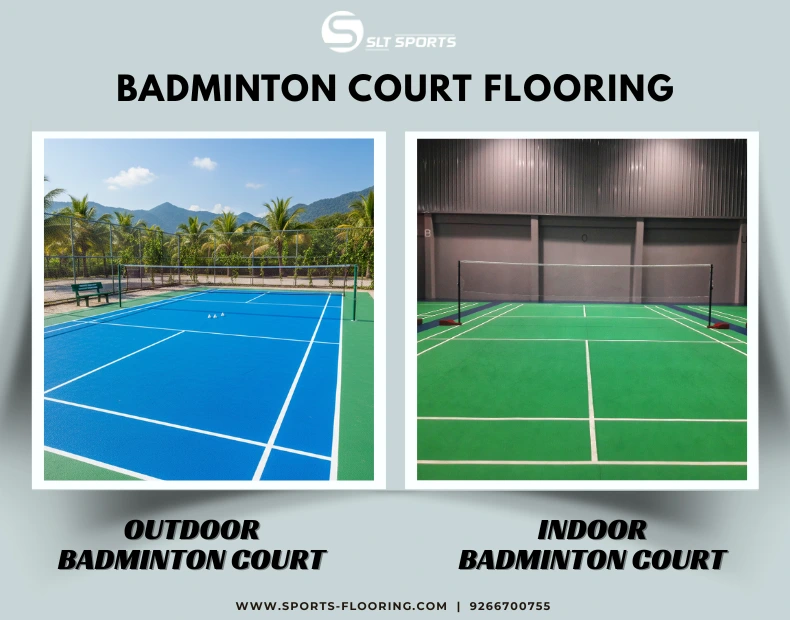
Indoor court builders care about a few key things:
- Comfort and shock absorption
- Controlled indoor grip
- Smooth, joint-friendly play
But with synthetic badminton flooring, you don’t have to worry about the moisture sensitivity that can ruin traditional wooden surfaces.
Outdoor courts must handle:
- Sun exposure and UV radiation
- Rain and humidity
- Temperature variation
SLT Sports uses weather-resistant synthetic outdoor badminton court flooring that:
- Drains water efficiently
- Prevents cracking and peeling
- Retains color and line clarity over time
Badminton Court Construction Details
SLT Sports follows a structured, layer-based installation process:
- Base Preparation: Concrete or asphalt base with proper slope and drainage
- Surface Repairs & Leveling Cracks and imperfections are treated to prevent future failure.
- Synthetic Resurfacer Layers: Ensures smoothness and uniform movement.
- Textured Synthetic Coatings: Provides controlled grip and stability.
- UV-Resistant Color Coats: Protects flooring and improves visibility.
- Accurate Line Marking: Applied strictly as per standard badminton dimensions.
Each stage contributes to the court’s safety, durability, and playability.
Flooring Maintenance & Long-Term Performance
For institutions, maintenance efficiency is a major concern, as synthetic badminton flooring offers:
- Easy cleaning
- Minimal downtime
- Periodic resurfacing instead of full replacement
This makes it ideal for schools, academies, and high-traffic sports complexes.
Why SLT Sports for Badminton Court Construction
SLT Sports is trusted for institutional badminton courts because of:
- Deep understanding of badminton court dimensions and markings
- Proven expertise in synthetic badminton court flooring
- Structured installation process
- Long-term performance focus rather than short-term aesthetics
Courts built by SLT Sports are designed to perform consistently day after day, year after year.
Conclusion
When it comes to badminton, every detail matters. Accurate court dimensions, precise court markings, and high-quality flooring systems are what separate the pros from the rest. Whether you’re training, competing, or just playing for fun, you need a court that’s safe, fun, and professional.
By combining regulation-compliant layouts with our top-notch synthetic badminton court flooring, SLT Sports delivers courts that meet the highest performance standards and stay practical for institutions too.
Frequently Asked Questions
Standard badminton courts are 13.4 m long, with a width of 6.1 m for doubles and 5.18 m for singles.
Synthetic badminton court flooring is ideal, as it offers controlled grip, durability, and low maintenance.
Yes, weather-resistant synthetic flooring systems make it possible to build outdoor badminton courts.
Yes, singles and doubles use different sides and service lines within the same court layout.