
Pickleball’s biggest plus point is that it doesn’t require a massive amount of land or the kind of professional sports infrastructure that other sports demand. As a result, the sport has really taken off in residential properties, villas & rooftops, schools, gated communities and other small, compact recreational spaces right across India. But while pickleball is well-suited to smaller areas, in fact, it’s probably better suited than most sports, planning a pickleball court in small area still needs some careful thought.
A badly planned compact pickleball court can end up feeling cramped, unsafe, noisy and just plain uncomfortable to play on. But, flip that on its head – a well-designed court in a small space can deliver a really smooth playing experience, safety and long-term enjoyment – even when space is at a premium.
This guide lays out what actually works when planning a pickleball court in a small area, covering the ins & outs of layout, what kind of surface you should choose, what safety must-haves you need to get right, and why synthetic acrylic floor systems from SLT Sports are ideally suited to compact pickleball courts.
Why Limited-Space Pickleball Courts Are Becoming More Common
Urbanisation, shrinking plot sizes, and rising interest in home-based recreation have made compact pickleball courts increasingly popular. Homeowners and facility planners are now converting:
- Backyards
- Rooftops
- Driveway extensions
- Community corners
- School courtyards
Unlike tennis or basketball, pickleball allows meaningful play in smaller areas, making it ideal for space-restricted environments—if planned correctly.
Start With Realistic Expectations, Not Just Measurements
One of the biggest errors people make when designing limited-space pickleball courts is getting caught up in just meeting the minimum pickleball court dimensions. Official pickleball playing dimensions are set – but how the space actually feels and works is just as important as whether it technically fits the rules.
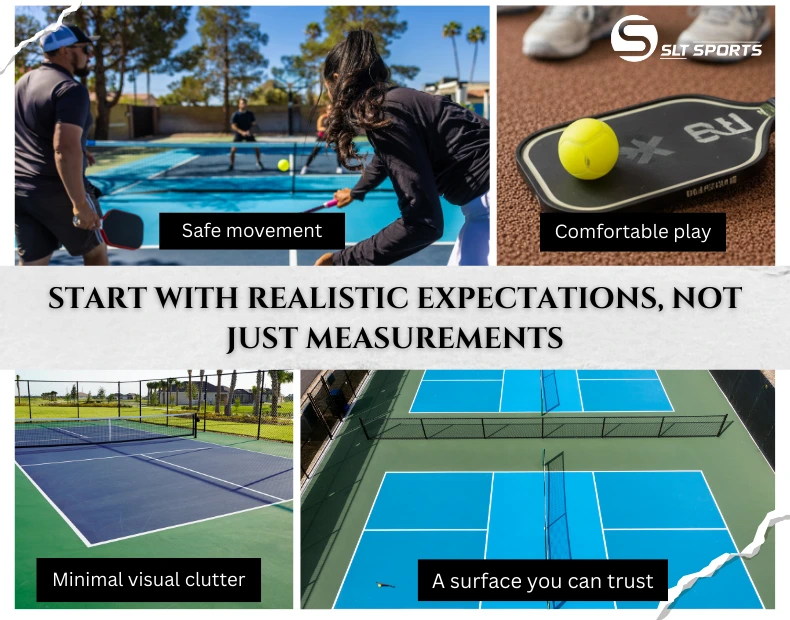
- Safe movement– In tiny courts, players have to think because they’re closer to all the boundaries and walls. This makes it essential that the layout lets players get in and out of the way of any obstacles without worrying about having a crash.
- Comfortable play– Limited space courts are often used for longer sessions rather than white-knuckle matches, so you really want to be sure the court feels nice underfoot. What you really want is a surface that’s got a nice balance of texture, a consistent feel and materials that look after your joints and muscles.
- A surface you can trust– In smaller courts, you really need to be able to rely on the court to behave itself – that means the surface should respond in a way that’s consistent all the way across the playing area.
- Minimal visual clutter– Too much colour – too many lines – it all adds up to a small court that feels cluttered and a bit of a mess. Keep it simple – go for a clean layout, choose a few colours that work well together and be sparing with the markings.
Understanding Minimum vs Practical Space Requirements
Official Playing Area
- Pickleball playing area: 20 ft × 44 ft
Practical Compact Layout
For small spaces, focus on clearance, not run-off. Typical compact recommendations:
- Side clearance: 4–5 ft (instead of 8–10 ft)
- Baseline clearance: 6–8 ft
- Total compact footprint: approx. 28–30 ft × 56–60 ft
This is smaller than tournament standards, but it works for recreational and residential play if designed well.
Smart Layout Strategies for Pickleball Court in Small Area
1. Remove Unnecessary Space, Not Safety Space
In compact designs, remove buffer zones—but never eliminate areas for stopping, turning or exiting the court safely.
2. Use Visual Boundaries
Fences, walls or contrasting surface colours help define the court and prevent players from drifting into unsafe areas.
3. Plan Entry and Exit Zones
Don’t put gates or entrances at the baseline or kitchen line. Even in small spaces, entry points shouldn’t interfere with play.
Surface Choice Becomes More Important in Limited Spaces
In large facilities, players can compensate for surface imperfections by moving. In small courts, surface behaviour is amplified. Pickleball court in small area needs:
- Controlled grip
- Uniform surface texture
- Seamless transitions
- Predictable bounce
That’s why synthetic acrylic pickleball court flooring outperforms basic concrete, tiles or painted surfaces in small spaces.
Why Synthetic Acrylic Flooring is Best for Small Areas
Synthetic acrylic flooring systems are designed for movement efficiency, which is crucial when space is limited. Key benefits:
- Seamless surface– Acrylic flooring is applied as a continuous system without tiles, joints or seams. In small areas, this eliminates uneven transitions that can trip you up or cause you to stop suddenly. A smooth surface allows you to move freely in any direction, even when time is of the essence.
- Balanced grip– The surface provides controlled traction, not too slippery and not too rough. This balance prevents you from stopping suddenly, which can strain your joints or lose your balance, especially in small courts where movements are quicker and more frequent.
- Consistent play– In small courts, you use every part of the surface. Acrylic systems maintain the same texture and performance from edge to edge, so you get predictable ball bounce and foot response.
- Customisable texture-based– The texture of acrylic flooring can be adjusted according to who will be using the court—kids, casual players, seniors or mixed groups. This flexibility allows small courts to be designed for comfort and safety without sacrificing playability.
In small courts, where every step counts, this consistency is a game-changer for comfort and safety.
Texture Balance: Factor in Compact Courts
Having too much texture in a small court can make all the difference in whether you feel like you’re working way harder than you should be – even if some people swear by highly textured surfaces looking super pro. But trust us, in a small court, they can do more harm than good – here are a few ways:
- Increased fatigue– Grippy surfaces wreak havoc with the friction between your shoe and the court. And with all that added resistance, you start to feel the strain, especially with casual players and older players.
- Abrupt stopping can be a real shock– Those super-grippy surfaces are trying to stop you in your tracks, which only makes it worse when you try to change direction in a small court. You end up feeling exhausted, which can be disorienting.
- Increased risk of injury– The harder your foot is working to grip the surface, the more you’re putting your joints through the wringer – especially in your ankles, knees. And on really rough surfaces, stopping is like especially if you’re playing in a small court.
- A smooth ride– When the surface feels just right, you can move around the court with ease and change direction without fighting the surface. It’s especially important in small courts where space is a luxury.
- Safe stopping– The surface helps you slow down smoothly, so movement feels natural and predictable. This improves both comfort and control while playing.
- Gentler joints– The surface reduces pressure on your joints, making the court safer and more comfortable for everyone—kids, adults, beginners, and experienced players alike.
This is especially important for residential and community courts, where you’ve got a mix of people of all ages and skill levels using the court.
Managing Walls, Fences, and Boundaries in Tight Spaces
When you have a pickleball court in small area, your boundaries are a lot closer, and that changes the way you play. Here are some things you can do to play it smart:
- Use padded fencing or add some kind of buffer zone near the walls
- Avoid having sharp corners right next to the play area
- Make sure there is a good visual contrast between the court and the boundaries
When you do things this way, you can avoid all sorts of hassle and improve the confidence of your players.
Noise Control Becomes a Design Issue
Noise is a big problem for a lot of people in small residential or community pickleball courts. While the surface itself can’t eliminate the sound of the paddle, the flooring you choose and how the court is laid out can make a big difference. Synthetic acrylic flooring is a good choice because it:
- Gives you a solid surface
- reduces vibration from the floor, transferring up to the players
- lets you add optional cushioning layers
How you place the court, what kind of fencing you use, and even what the landscaping is like around the court all play a part in reducing the noise levels.
Drainage Planning Is Non-Negotiable in Small Courts
Limited space often means shared drainage with areas nearby, like gardens, driveways, or patios. To make a pickleball court in small area work:
- You need to get the slope right – it’s not just about how it looks
- Water has to be directed away from the playing area – no puddles allowed
- And you can’t have water pooling up at edges or corners
Synthetic acrylic courts do work really well when paired with some thought put into drainage planning – that way, the surface stays playable even after a rainstorm.
Multi-Use Planning: Getting More From Less Space
One of the smartest ways to justify a compact pickleball court is to design it so it can be used for a few different things. Some of the more popular multi-use options include:
- Pickleball and badminton
- Pickleball and a general recreational play area
- Pickleball and a warm-up court for those heading out onto the main track
Synthetic acrylic flooring is really handy because the lines don’t get in the way, which makes multi-use layouts possible and looks pretty good.
Visual Integration in Small Spaces
In an area that’s tightly packed, the wrong colour choice or a few too many line markings can make a court feel cramped and overwhelming.
For a compact court:
- You should probably aim for a lighter or neutral colour
- Try not to overdo it with the line markings
- If you can, try to blend the court in with the surrounding architecture
Acrylic flooring systems offer you a wide range of colours to choose from, which makes it a lot easier to create a small court that feels open and airy rather than boxed in.
Maintenance Expectations in Compact Pickleball Courts
Smaller courts can be pretty tough on the surface – especially in the high-movement areas. One of the real advantages of a premium acrylic flooring is that it develops even wear patterns, which means you can see exactly when it’s time to resurface and keep things nice and predictable. It also makes the cleaning a doddle – so even if you are using the court a lot, it stays in good condition.
Industry Reference for Pickleball Court Planning
When it comes to official pickleball guidelines, USA Pickleball is the go-to reference for correct court dimensions, surface performance and safety for recreational play. Homeowners and planners can pull from these standard references.
Common Mistakes in Small Pickleball Court Planning
- Thinking that it’s all about the dimensions – and ignoring how people will use the court
- Using decorative paint instead of actual sports flooring – it’s a false economy in the end.
- Failing to take into account wall and fence safety -it’s a big oversight
- Over-texturing the surface -it’s just too much
- Not thinking about drainage – leaving it out of the planning altogether
If you can avoid these mistakes, then you can ensure that your court is one that actually works – not just looks good.
Why SLT Sports Is Ideal for Limited-Space Pickleball Courts
SLT Sports specialises in producing synthetic acrylic sports flooring systems – these are designed to keep performing in all kinds of conditions, including the tightest of spaces. For limited-space pickleball courts, SLT Sports can deliver:
- Acrylic systems with a controlled texture
- Formulations that are tailored to local climates
- Seamless – joint-free surfaces
- Years of service life with a minimum of fuss
And we can even provide tailored guidance for small space layouts’s not just about getting a court to fit into a space – we want to make it so that it’s going to stay playable, safe and durable for as long as possible.
Final Thoughts
Just because you have a small space doesn’t mean you can’t have a fun and functional pickleball court – if you plan it properly. With the right strategy, a good surface material, and some careful attention to detail, a compact court can deliver a great experience. And by choosing top-of-the-line synthetic acrylic flooring systems from SLT Sports, homeowners can create a high-quality court that stays in good nick for years to come
Frequently Asked Questions
Pickleball courts work well in small spaces when planned carefully with proper clearances and the right surface.
Yes, acrylic courts withstand the elements and perform reliably in small outdoor spaces.
With quality materials and proper construction, a small court can last 5–7 years or longer.
Not if planned well—proper layout, balanced texture, and safety zones significantly reduce injury risk.