
Tennis courts are investments that are meant to last. Whether someone’s building them for a tennis academy, a club, a school, a residential development, or a professional facility, the surface you choose is what ultimately determines how well the court holds up over the years and stays safe and consistent. It’s been a while now since tennis court construction stopped being some old-fashioned affair and started to adopt new technology – we’ve moved on from traditional surfaces to more modern synthetic options. One of the biggest changes in recent years has been the growing number of people turning to synthetic tennis court materials, in particular, synthetic acrylic surface flooring systems. To be honest, when you compare them to the traditional surfaces like clay, grass or just plain old concrete, these synthetic courts prove to be a hell of a lot more durable, a lot more predictable, and they save facilities a lot of cash in the long run.
This article is going to explain just why synthetic tennis court materials last so much longer than traditional surfaces, how they handle the strains of the climate a lot better, and why so many facilities in India are turning to acrylic-based systems from experienced manufacturers like SLT Sports.
Understanding Traditional Tennis Court Surfaces
Before getting into the question of how long a tennis court lasts, it’s worth taking a step back to see what traditional tennis courts are actually made of and where they fall down.
Clay Tennis Courts
Clay courts are famous for their slow pace, which is nice for rallies and balls that bounce like anything, but do they need looking after? You can’t just knock them about daily and expect them to keep going – you need to be rolling them over every day, giving them a good soaking, and just constantly topping them up in the hope that they stay together.
Weather can suddenly change, and that surface consistency that’s so important suddenly gets all out of whack – and before you know it, wear and tear is straight through the surface, and the erosion begins.
Grass Tennis Courts
Grass courts give you the speed and the good looks – but are they temperamental? Heavy use and changing weather conditions quickly turn your decent grass court into a mess of bald patches and uneven bounces. Re-seeding them is a regular occurrence, as is mowing and irrigation – and still you can’t guarantee they wont go to pot.
Concrete & Asphalt Courts
Concrete and asphalt bases are more than solid – but even that wont save them from cracking and fading the moment the sun hits – let alone the rain and temperature changes. All that UV stuff will see to it that the surface pretty quickly breaks down and starts becoming a safety risk.
Traditional surfaces have got to have a constant input of time and money to stay going – and they’re still totally exposed to just about any weather you care to throw at them. It’s no wonder synthetic tennis courts leave them in the shade.
What Are Synthetic Tennis Court Materials?
Synthetic tennis surfaces are made up of multi-layer acrylic coating systems slapped onto a stable concrete or asphalt base. They’ve been specifically designed to give you top-notch sports performance, durability and climate resistance.
So, what does a standard synthetic tennis court comprise:
- You’ve got to have a solid concrete or asphalt base to start with
- Then an acrylic primer to get things going
- Some resurfacer layers to bring it all together
- Optional cushion coats for extra shock absorption
- More acrylic colour coats to make it look the part
- And to finish it off, a textured finish for grip and a line marking system
Unlike the old traditional surfaces, these layers all work together to protect the base and give you consistent play – no slippage and no uneven bounce.
Why Synthetic Tennis Court Materials Last Longer?
1. Superior Resistance to Weather Conditions
One big reason synthetic tennis court surfaces last longer is that they just don’t break under the heat of the sun, the rain and the dust.
India’s climate is especially tough on tennis courts with:
- Blistering heat
- Endless UV rays
- Heavy downpours during the monsoons
- Dust and pollution swirl everywhere
- The constant temperature fluctuations
Synthetic acrylic coatings are super resistant to UV damage, water and temperature changes, so they can expand and shrink without cracking or flaking off. Traditional surfaces like clay and unprotected concrete just can’t take it, and they degrade in no time.
This means that synthetic tennis courts can keep going strong long after the competition has moved on.
2. Strong Protection for the Base Structure
Tennis courts typically crack from the base upwards. Synthetic tennis court systems act as a vital umbrella, shielding the concrete or asphalt layer from the elements.
Acrylic resurfacer and cushion layers:
- Take the strain and absorb the pressure
- Help prevent those tiny cracks from forming
- Keep water out of where it shouldn’t be – right down at the base
- Stop the constant pounding from wearing down the structure
Traditional courts, however, leave the base wide open to the stresses of the environment, which only speeds up the deterioration process. By putting a protective barrier in place, synthetic systems ensure that your court lasts longer and needs fewer major repairs.
3. Consistent Surface Performance Over Time
Just because something lasts a long time, doesn’t mean it’s still any good – longevity is also about performance.
Synthetic tennis court materials are engineered to maintain:
- A ball bounce that stays consistent
- A grip on the surface that you can rely on
- A speed that you can anticipate
- The safety of the players on the court
Traditional surfaces, on the other hand, change all the time as they age – Clay courts slow down in an uneven way, grass courts lose all bounce, and concrete courts turn into slippery or abrasive messes. Synthetic acrylic surfaces, however, are designed to perform the same for years without losing any of their characteristics.
4. Weaker Wear from Player Movement
Traditional tennis court surfaces wear down incredibly fast due to all the foot traffic. Sliding, pivoting, and that constant pounding – it all does its fair share of damage to clay and grass surfaces.
Synthetic acrylic tennis courts, however:
- Take the pressure and distribute it evenly
- Reduce all that surface abrasion and stop the surface peeling and erosion.
This controlled wear pattern means that synthetic courts can outlast traditional surfaces – even at the busiest clubs and academies.
5. Minimal Water and Maintenance Dependency
Traditional tennis courts always need a lot of upkeep just to be usable. You’d have to water and groom a clay court every day, or mow and irrigate a grass court.
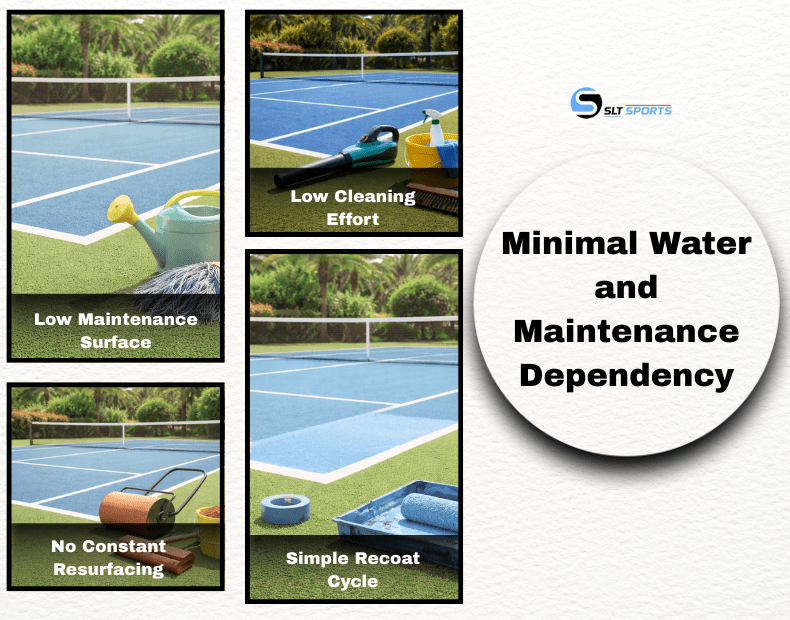
Synthetic tennis court materials take all that pressure off:
- No more watering or daily maintenance on your hands
- No more constant rolling and resurfacing
- Cleaning is a breeze – and rarely needs doing
- Just recoat every few years
The result is a longer lifespan for your court because it’s not being constantly messed with.
6. Advanced Material Engineering
What you get with modern synthetic tennis courts is years and years of R&D wrapped up in Acrylic polymers that offer:
- Serious strength
- Flexibility when the going gets tough
- Strong bonds to the base that really last
- None of those nasty chemical breakdowns
All that science & technology means that your surface is going to age slowly and sensibly over the years…and not fall apart in an unpredictable heap like some other materials might.
7. Easier Repair and Resurfacing Cycles
Even the best surfaces will eventually need work. But synthetic tennis courts are designed to be easily resurfaced – without replacing the base.
That’s a big advantage:
- Fix a crack, and you’re back in business
- Partial resurfacing – no need to clear the whole court
- New topcoat and you’re good to go – no need to take the court apart
The traditional approach too often means just giving up and starting from scratch, and that just cuts into how long the court lasts.
8. Long-Term Cost Efficiency Equals Longevity
Durability and cost-efficiency go hand in hand. Synthetic tennis courts:
- Mean fewer emergency repairs to deal with
- No seasonal shutdowns – always open for game
- Consistent, all-year-round playability
So your court stays usable – for years and years – and that means the upkeep is kept to a minimum too. Over 10-15 years, you’d be lucky to beat the total cost of a synthetic tennis court with a traditional one.
Why SLT Sports Synthetic Tennis Courts Last Longer?
SLT Sports are the ones who have perfected the art of making really tough, really long-lasting synthetic acrylic tennis court surfaces.
The secret to their success is these key strengths we’ve come to rely on:
- Our climate-adapted acrylic formulas – they keep performing even in the most extreme weather
- The multi-layer coating systems we use to make sure your court stays in top shape
- Consistent quality in every batch of material we produce
- Plus, we offer installation guidance to help you get years and years of reliable performance out of your new court. And we’ve got solutions for all sorts of venues – schools, academies, clubs, and even professional facilities.
At SLT Sports, we put durability first and foremost. That’s why our surfaces stay safe, look great, and stay playable for all the years you’ll be using them.
Environmental and Sustainability Benefits
Synthetic tennis courts are a more eco-friendly option
- They use a lot less water than real grass
- You’ll need to replace the surface a whole lot less often
- They’re less heavy on chemicals
- And you can go years without needing to resurface the whole thing
According to the experts at the International Tennis Federation, acrylic-based surfaces are one of the most environmentally friendly options for places that see a lot of action.
Synthetic vs Traditional Tennis Court Longevity Comparison
| Surface Type | Average Lifespan | Maintenance Level | Climate Resistance |
| Clay Court | 5–7 years | Very High | Low |
| Grass Court | 3–5 years | Extremely High | Very Low |
| Plain Concrete | 6–8 years | Medium | Low |
| Synthetic Acrylic | 10–15+ years | Low | High |
Conclusion
The shift to synthetic tennis court materials is no fleeting fad – it’s the smart call when you want a pitch that holds up to modern demands, the elements and regular wear and tear. Traditional surfaces just can’t keep up with what we expect from them.
A top-notch synthetic acrylic tennis court, especially one from a company like SLT Sports that’s been in the game for ages, will last longer, play more consistently, and require less of a financial outlay in the long run. For anyone serious about building a court that’s going to last, then synthetic is the way to go.
Frequently Asked Questions:
Synthetic courts are way more weather-resistant, require less tinkering, and shield the base from damage, whereas clay courts just don’t stand up as well to the elements.
If you give it the right installation and maintenance, a synthetic acrylic court is good for 10-15 years or more before you need to pull out the big guns and resurface the whole thing.
Absolutely, it will. Synthetic acrylic court materials are made with heat, UV rays and all the rest in mind – they’re designed to handle the Indian climate.
You might get some minor surface cracks along the way, but because they’re so flexible, acrylic systems prevent those little cracks from spreading further down to the base.
Absolutely, you don’t need to be watering, rolling or giving it a daily groom – just a quick clean and occasional recoat.
SLT Sports have got it down to a science – they offer climate-optimized acrylic systems, proven durability and the expertise to build a top-notch court that’s going to last.