
Volleyball is quickly becoming one of the hottest sports in India – with activity really taking off in schools, universities, gated communities & local sports centres. As more & more young players are taking part in youth leagues, community tournaments & casual games, the need for top-grade volleyball courts – both indoors & outdoor – is getting to be a real priority. For anyone thinking about starting a new facility, it’s pretty crucial to get a handle on what a volleyball court construction cost would be to build.
Schools and colleges need to get their budgeting right if they’re going to upgrade their infrastructure, while housing societies are just looking for a safe place for their residents to go and get some exercise, and private sports academies need courts that can stand up to the demands of competitive volleyball. Having a clear idea of what a volleyball project should cost helps avoid a ton of unnecessary expense & ensures that the finished court is built to last, with materials & dimensions that fit the job.
There are a whole bunch of factors that can drive up the final cost (Synthetic Acrylic, Wooden Flooring or Beach Courts – each one has its pros & cons), so does the type of sub-base you choose, how much preparation work you need to do on site, and just what the local climate is like. In other words, what kind of flooring you end up with, and how you get the site ready for play all have a big impact on the cost both upfront and down the line.
Types of Volleyball Courts & Their Cost Influence
Outdoor Volleyball Court
Outdoor volleyball courts are the most popular choice for schools, parks, sports complexes, colleges and clubs – and for good reason. Not only are they easy to use, but they don’t break the bank when it comes to construction costs.
It’s worth noting the costs of an outdoor court can vary significantly, mainly because of the following:
- The base: will you go for a concrete, asphalt, or bitumen sub-base? Each option has its pros and cons when it comes to cost.
- Flooring: synthetic acrylic flooring is super popular – and for good reason – it’s super durable and weather resistant.
- Fencing: a 10-12 ft chain-link fence adds a bit extra to the bill, but it’s worth it for the added security and style.
- Lighting (if you want to play at night): LED floodlights can add a bit to the cost, but they make evening games a lot more enjoyable.
While outdoor volleyball court flooring are definitely the more economical option – they do need a bit of extra TLC to keep them in good nick, especially here in India’s climate. Proper drainage and weather-proof coatings are a must.
Indoor Volleyball Court
Indoor volleyball courts are mostly found in top level stadiums, sports academies, international schools and multi-sports arenas.
As you’d expect, the construction costs of an indoor volleyball court are a bit higher due to:
- The flooring: You’ve got a choice of premium options like wooden sports flooring, synthetic PU flooring, or vinyl surfaces. Each option comes with its own price tag.
- Structural stuff: You need to factor in the cost of a roof, steel structures and insulated walls.
- Lighting and ventilation: Indoor LED systems and airflow management are a must for comfortable play.
- The labour costs: It takes a team of skilled tradespeople to prepare and finish the surface – and that costs money
Indoor courts are definitely the way to go if you want the best possible play experience – but they’re definitely the most expensive upfront investment.
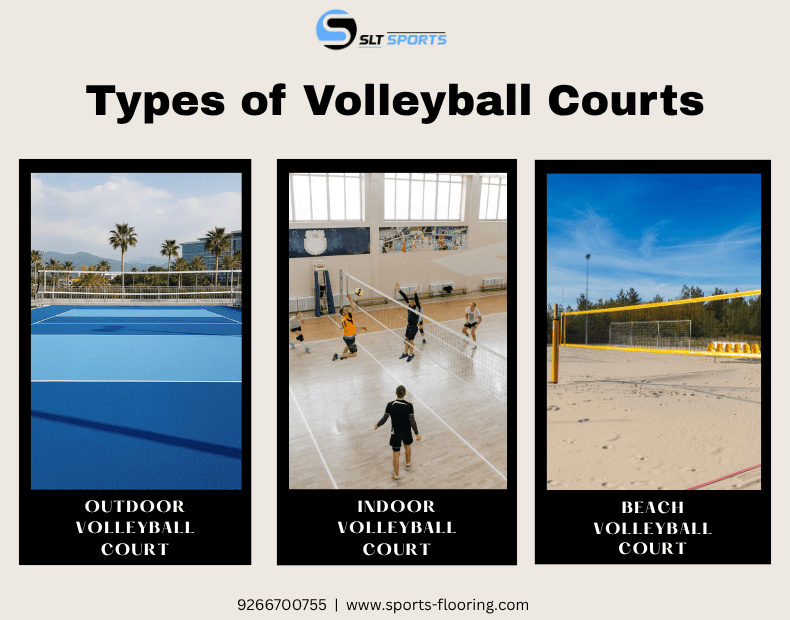
Beach Volleyball Court
Beach volleyball courts are becoming really popular at resorts, beach clubs, universities and parks – and it’s easy to see why. They look great and are a lot of fun.
But it’s worth noting that building a beach court comes with a few extra costs, including:
- The sand: you need to get high-grade stuff that is soft, clean and rounded – perfect for barefoot play.
- Drainage: you need a proper system in place to prevent the sand from becoming waterlogged or hard.
- Court edges and borders: you can go for wooden or PVC frames – both are stylish and durable.
- Ongoing sand maintenance: this one’s a bit of a pain, as you need to rake, level and replace the sand regularly.
- Optional extras: you might want to consider adding a shade structure, some seats or fencing to really make your beach court stand out
Beach courts are great fun, but they do need a bit more TLC than solid-surface courts.
Standard Volleyball Court Dimensions & Area
A regulation volleyball court dimensions comes out at 18 by 9 metres (give or take 59 ft by 29.5 ft). The official playing area is a starting point, but you need to factor in some extra space around the court for safety and ease of movement.
Most pro courts end up needing:
- Total construction space: it’s around 28m by 19m, so you’re looking at a fair-sized footprint including that free zone
- Free zone width: usually a minimum of 3m–5m of clear space all the way around
- Clear running space: this one’s pretty obvious for a competitive match, but it’s also essential for safety
All that extra space has a knock-on effect on the overall cost of building the court, since it means more flooring, fencing, lighting, and groundwork.
Factors That Affect Volleyball Court Construction Costs
Building a volleyball court involves a number of technical and material considerations. Each factor – flooring, groundwork, site preparation, accessories, fencing, lighting, and location – will impact the final bill, so it’s worth getting to know them.
What Kind of Volleyball Flooring Material Do You Choose
The flooring material of volleyball will be a major cost contributor. Different volleyball surfaces have different strengths and weaknesses when it comes to durability, how they interact with the ball, comfort, and maintenance.
Synthetic Acrylic Flooring (The Cheapest Option for Outdoor Courts)
Synthetic acrylic flooring is a popular choice for outdoor volleyball courts in India – it’s affordable, resistant to UV rays, slip-resistant, and can handle the weather.
- Perfect for schools, clubs, and residential areas with limited budgets
- Gets a good grip and can help reduce injuries
- Lower maintenance than clay or wooden courts
- Long-term value is high
Costs: This usually works out as the most cost-effective of the high-end options.
Interlocking PP Tiles
PP (polypropylene) modular tiles are usually used for portable or quick-fit courts.
- Can handle the sunlight.
- They’ve got a shock-absorbing design.
- Come in a range of colours.
- Good for places where you don’t want to do a full-on flooring job.
Cost: A bit pricier than acrylic because of the individual tile work and the extra setup required.
Wooden Sports Flooring (Only for Indoor Courts)
Wooden courts offer the ideal bounce and cushioning for indoor pro volleyball.
- Top-notch performance in indoor matches
- Using a maple or teak layered finish
- Needs to be in a controlled indoor climate
- Needs regular polishing and upkeep – which can be a hassle
Cost: One of the most expensive flooring options – mainly because of the materials and the complexity of the installation.
PU (Polyurethane) Sports Flooring
PU floors are seamless, cushioned, and often chosen for high-end indoor sports facilities.
- Excellent shock absorption
- Provides a consistent playing surface
- Lasts for a long time under indoor conditions
- Not the cheapest installation in the world, unfortunately
Cost: Comparable to high-end wooden flooring in terms of cost – might be a bit lower depending on how thick the surface is.
Sub-Base
The sub-base is the foundation of any volleyball court and more than half of the court’s long term performance depends on how well this layer is built. A M20 grade concrete base with 4 to 5 inches thickness is the most durable and stable option. It supports acrylic and PP tile flooring systems, prevents cracks and settles evenly over time. However it must be built with the correct drainage slope so water doesn’t accumulate on the surface. Although a concrete base is more expensive than other options, its long term durability makes it the preferred choice for professional courts.
A bitumen (asphalt) base is another common surface because it’s flexible and quick to install. It pairs well with acrylic coatings but may require more maintenance in areas with extreme heat. Bitumen construction is cheaper than concrete but the need for resurfacing or patchwork sooner can affect long term budgeting.
Before any base is built, the site must be properly analyzed and prepared. Soil testing, compaction and levelling are essential to ensure stability. If the land is uneven, excavation and aggregate filling may be required. The base must also be shaped with a 1:100 drainage slope so water flows naturally away from the playing area. These preparatory steps affect the final cost depending on how soft, uneven or unstable the ground is.
Site Preparation
Site preparation is critical to ensure the safety and longevity of the volleyball court. The process starts with clearing the land by removing grass, debris and any existing structures. Once the surface is clean, the soil is compacted using rollers or heavy compactors to create a stable foundation. Proper drainage planning is important at this stage to prevent water accumulation during monsoon season. If a concrete base is being installed, it requires a 21 to 28 days curing period before any sports flooring can be applied. Poor site preparation often leads to premature surface deterioration, cracking or water related damage and higher repair cost later.
Accessories
Accessories complete the volleyball court and affect usability and cost. A standard setup includes steel or powder coated net posts, official volleyball net and pole padding to ensure player safety. Court markings are applied with specialized line marking paint to ensure visibility and compliance to dimensions. Some courts also use boundary tape for temporary or practice layouts. Although these accessories may seem like small things, they are part of the fully functional court and must be included in the total project cost.
Fencing & Lighting
Fencing is one of the most important things for outdoor volleyball courts especially in schools, parks and residential societies. A 10-12 ft chain-link fence prevents the ball from going out of the court, improves player safety and gives the facility a more organized look. Fencing cost depends on the height, spacing of the poles and thickness of the wire, GI and PVC coated options are commonly used.
Lighting, especially LED floodlights, extends the playing hours and makes the facility usable in the evening. Courts require 2-4 poles with 200W to 400W LED units depending on the level of illumination needed. Pole height is usually 16-20 ft. Better lighting coverage improves visibility but increases cost due to additional fixtures and wiring.
Location & Labour Costs
The cost of volleyball court construction varies greatly based on the location. Labour charges are higher in metro cities and material transport cost may be higher in remote areas. Availability of skilled contractors also affects the pricing, regions with fewer sports flooring professionals may require additional travel or higher installation charges. Local climate conditions – high UV exposure, extreme rain or humidity – can influence the selection of flooring material and surface coating, indirectly impacting the overall cost. For example, constructing a court in a hilly or hard to reach area may increase logistics cost, while urban areas may have easier access to materials but higher labour rates.
Volleyball Court Construction Cost in India
Volleyball court construction cost in India varies based on flooring material, base construction, accessories and site conditions. Since outdoor acrylic courts are most common, their cost structure is taken as a baseline. Below is the breakdown for a standard 18m x 9m playing area with recommended free zones.
Flooring Cost
Flooring is the largest cost component as it defines the court’s performance, durability and maintenance needs. Acrylic sports flooring is the most widely used option due to its affordability and weather resistance. The cost for a high quality multi-layer acrylic system is between ₹55 to ₹85 per sq.ft depending on the number of layers and quality of materials.
PP tiles, chosen for portable or low maintenance courts, are priced higher due to its modular design and UV stable construction. The cost is between ₹160 and ₹240 per sq.ft.For indoor courts, wooden sports flooring provides the best cushioning and bounce. These systems cost between ₹350 to ₹600 per sq.ft depending on the wood – maple, teak or engineered. PU sports flooring is another premium indoor option, costs between ₹280 to ₹450 per sq.ft depending on the thickness and cushioning layers.
Base Cost
The sub-base is the foundation of the court. Concrete bases made with M20 grade and 4–5 inch thickness are the most durable in India and cost around ₹120 to ₹160 per sq.ft. Bitumen (asphalt) bases are quicker to install and cheaper at around ₹90 to ₹130 per sq.ft but require more maintenance especially in extreme heat. These costs vary depending on excavation depth, soil stability and drainage requirements.
Additional Costs
Beyond the flooring and base, there are several other essential elements that complete the volleyball court. Net posts and a good quality volleyball net add a small amount to the project but are necessary for play. Fencing is one of the bigger additions; a 10–12 ft chain-link fence with GI or PVC coated wire adds to the cost depending on the perimeter length. Lighting especially with LED floodlights installed on 16–20 ft poles adds to the cost for wiring, poles and fittings. Optional seating areas, whether simple benches or small stands may also add to the cost for schools and clubs that need spectator space.
Total Estimated Cost Range
An Outdoor Synthetic Acrylic Volleyball Court costs around ₹4.5 lakh to ₹9 lakh depending on base construction, fencing height, lighting and customization. Whereas indoor Wooden Volleyball Court due to the premium flooring, steel structure, roofing and indoor lighting costs around ₹18 lakh to ₹35 lakh. A Beach Volleyball Court depending on sand quality, drainage design, edging and optional shading structures costs ₹3 lakh to ₹7 lakh.
Indoor vs Outdoor Volleyball Court Cost: Comparison Table
| Feature | Outdoor Acrylic Volleyball Court | Indoor Wooden/PU Volleyball Court |
| Flooring Cost | Lower; acrylic or PP tiles | Higher; wooden or PU systems |
| Maintenance Cost | Minimal; occasional repainting | Moderate to high; polishing or resurfacing required |
| Lifespan | 5–7 years before resurfacing | 8–12 years with proper care |
| Installation Time | Faster; 15–25 days including curing | Longer; 30–60 days due to structure and flooring |
| Year-Round Usability | Weather-dependent | All-season play, completely protected |
Indoor courts offer unmatched playability and aesthetics, while outdoor courts provide the most economical, quick-to-build option for schools, communities, and academies.
How to Reduce Volleyball Court Construction Cost
There are many ways to reduce the cost without compromising on performance. Choosing acrylic flooring is one of the best ways as it gives a great playing surface at a much lower cost than wooden or PU systems. Getting the court design and layout right from the beginning saves costly modifications later. Proper site levelling is important—not only it improves drainage but also reduces the risk of future structural issues that lead to repairs.
Hiring experienced volleyball court builders plays a big role in long term savings as professional installers ensure correct base construction, slope alignment and coating application. Using long life, UV resistant coatings further reduces maintenance cost and ensures the court retains its color and performance for many years. By combining the right materials with expert installation you can reduce both construction cost and lifetime ownership cost.
SLT Sports is a trusted name in synthetic acrylic sports flooring, delivering certified, durable, and performance-driven courts across India. With 14+ years of expertise, we offer safe, weather-resistant, and low-maintenance surfaces for schools, sports complexes, academies, and clubs. Our multi-layer acrylic systems are designed for tennis, basketball, volleyball, badminton, pickleball, skating rinks, walking tracks, and multipurpose courts.
Maintenance Cost After Installation
Once the volleyball court is built, it requires minimal but consistent maintenance. Regular cleaning is the most important step—removing dust, leaves, mud and standing water helps protect the surface from premature wear. Outdoor acrylic courts only need periodic washing and light brushing to maintain traction and color. Repainting or resurfacing is required every 4-5 years depending on usage and weather exposure. This restores color vibrancy, improves grip and protects the surface from UV damage.
Net systems and accessories like pole padding and boundary markers may wear out due to daily use and weathering. These components need to be replaced every 2-3 years though the cost is relatively low compared to the main flooring.
Overall the annual maintenance cost for an outdoor acrylic volleyball court is affordable, usually ranging between ₹10,000 to ₹25,000 per year depending on usage, location and surface type. Indoor courts may require slightly higher maintenance due to cleaning systems and wooden floor polishing but still offer great long term value when maintained properly.
Conclusion
Building a volleyball court in India is a bit of a minefield, with loads of things to think about – such as the cost of flooring, laying down a solid base beneath it, fencing it in, getting the lighting right & all those finishing touches. On top of all that, the state of the soil, how you prepare the site and just the overall design are all key factors in determining how much your court is going to set you back.
Choosing the right flooring material is not only going to affect how much the initial build costs, but also how much you’ll be chucking down over the court’s lifespan. Take Acrylic flooring for example – it strikes a nice balance between being affordable, long-lasting & low maintenance & its the go-to choice for most schools, clubs, societies & academies for that reason. Then at the other end of the scale you have your high class floorings like wooden or PU flooring that deliver the goods, but come with a higher price tag & need to be frequently resurfaced to keep on top of things. But, when you pair the right flooring with a decent base that’s been properly installed, you can pretty much guarantee a surface that’s consistently playable for years to come & cuts your long-term repair bills down to size.
If you’re planning to get a volleyball court built and want a proper estimate for your site, SLT Sports can hook you up with a custom design, budget and build. Just give us a call and we can provide you with some expert advice, recommendations on the best materials for your project & get you a quote that fits your budget.
Frequently Asked Questions
Acrylic flooring is the cheapest and most cost-effective outdoor volleyball court surface.
Construction usually takes 25-30 days, including base curing and flooring installation.
Yes, you can build a volleyball court in a backyard if you have enough space for the court and safety zones.
No, acrylic courts need minimal maintenance—mainly simple cleaning and repainting every 4–5 years.
Synthetic flooring typically lasts 5–7 years before resurfacing is needed.